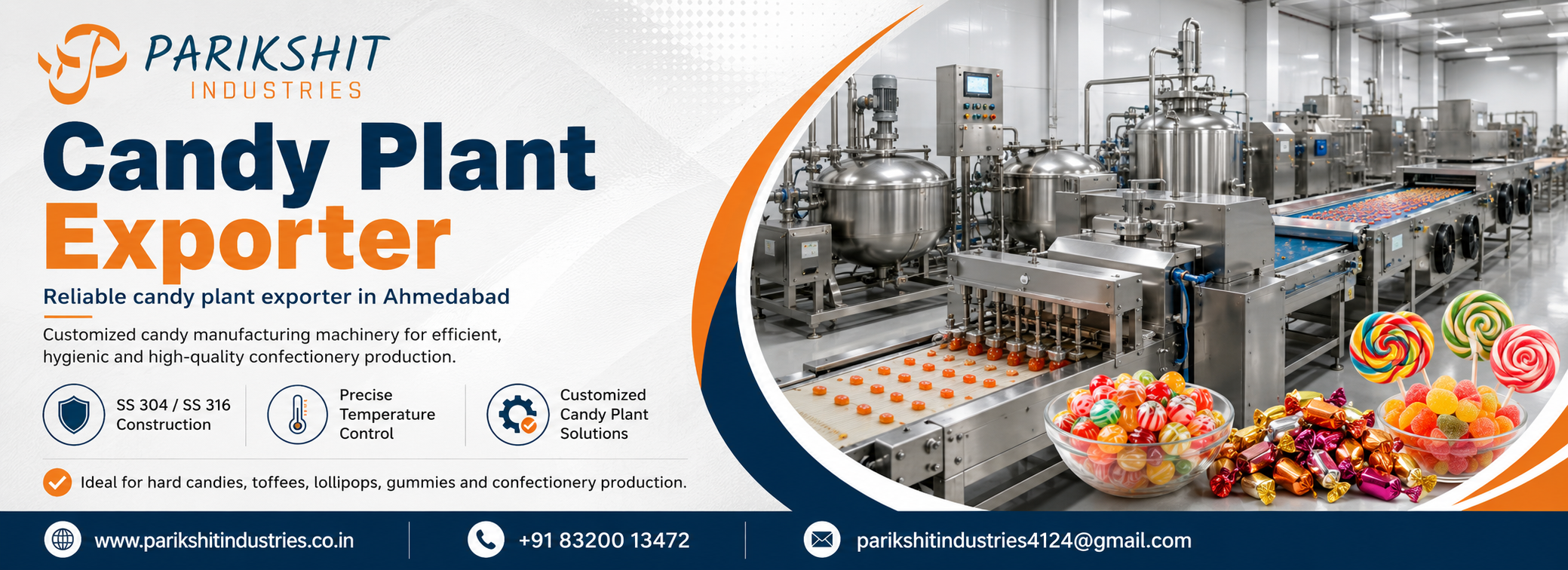
Candy Plant Exporter
Seeking a reliable candy plant exporter in Ahmedabad? Parikshit Industries offers high-quality, customized candy manufacturing machinery and complete plant solu
Why This Matters in Ahmedabad
Ahmedabad, Gujarat, stands as a significant industrial and manufacturing center in India. Its strategic location and well-developed infrastructure make it an attractive base for food processing industries. The region boasts a growing entrepreneurial spirit and a strong demand for diverse food products, including confectionery. Businesses in and around Ahmedabad require access to advanced, reliable machinery to compete effectively in both domestic and international markets. Partnering with a local, experienced candy plant exporter ensures access to specialized equipment tailored to production needs, supported by timely service and understanding of regional industrial standards.
What is a Candy Plant — Overview
A candy plant refers to a comprehensive set of machinery and equipment designed for the industrial-scale production of various types of candies and sweets. This includes everything from raw material handling and mixing to cooking, shaping, cooling, and packaging. The core of a candy plant is its processing line, which can be configured for specific products like hard candies, caramels, toffees, lollipops, or chocolates. These plants are engineered to ensure consistent product quality, adherence to hygiene standards, and efficient throughput, transforming basic ingredients into finished confectionery items.
Key Features and Technical Specifications
When evaluating candy plant machinery, several key features and specifications are critical for operational success and product quality. These ensure the equipment is robust, efficient, and capable of meeting production demands.
- Material Construction: Food-grade stainless steel (e.g., SS304, SS316) for all contact parts to ensure hygiene and durability.
- Capacity and Throughput: Designed to meet specific production volumes, from small-batch artisanal needs to large-scale industrial output.
- Temperature Control: Precise digital temperature control systems for cooking, tempering, and cooling stages to ensure consistent product texture and quality.
- Mixing and Homogenization: Advanced mixing systems for uniform blending of ingredients, crucial for flavor and texture consistency.
- Shaping and Forming Mechanisms: Versatile forming machines capable of producing various candy shapes and sizes, often with interchangeable molds.
- Cooling Systems: Efficient cooling tunnels or chambers to rapidly set candies, preventing deformation and ensuring proper texture development.
- Automation and Control: Integrated PLC (Programmable Logic Controller) systems for automated operation, monitoring, and precise control over process parameters.
- Energy Efficiency: Designed with energy-saving features to reduce operational costs and environmental impact.
Industrial Applications and Use Cases
Candy plants are versatile, serving a wide array of confectionery products and catering to diverse market demands. Their application extends across various segments of the food industry.
- Hard Candy Production: Manufacturing clear, boiled sweets, fruit drops, and medicated lozenges.
- Caramel and Toffee Manufacturing: Producing chewy or firm caramels, toffees, and fudges with consistent texture.
- Lollipop Production: Creating stick candies in various shapes, sizes, and flavors.
- Gummy and Jelly Candy Production: Manufacturing soft, chewy candies using gelatin or pectin bases.
- Chocolate Confectionery: While often a separate specialization, some plants can integrate chocolate coating or molding capabilities.
- Nut and Fruit-Based Confections: Producing bars or clusters incorporating nuts, dried fruits, and other inclusions.
- Custom Specialty Candies: Enabling the creation of unique, niche confectionery products for specific markets or brands.
- Industrial Scale Sweet Production: Supplying large manufacturers requiring high-volume, consistent output for mass-market distribution.
How to Choose the Right Candy Plant
Selecting the appropriate candy plant is a significant investment that requires careful consideration of several factors to ensure it aligns with your business objectives and operational capabilities.
- Product Specialization: Clearly define the types of candies you intend to produce. Different machines are optimized for hard candies, chewy candies, chocolates, etc.
- Production Capacity: Determine your required output volume (e.g., kg per hour, tons per day). The plant must be sized to meet current and projected demand.
- Automation Level: Decide on the desired level of automation. Fully automated lines offer higher efficiency but require a larger initial investment and skilled operators.
- Space and Infrastructure: Assess the available factory space, power supply, water, and ventilation requirements of the machinery.
- Supplier Reputation and Support: Research the manufacturer's experience, customer testimonials, and the availability of after-sales service, spare parts, and technical assistance.
- Compliance and Certifications: Ensure the machinery meets relevant food safety standards (e.g., GMP, HACCP) and local regulatory requirements.
- Customization Options: If you have unique product requirements or process needs, verify the supplier's ability to customize the plant.
- Budget and ROI: Balance the initial cost with the expected return on investment, considering operational efficiency, product quality, and maintenance costs.
Quality Standards and Compliance
Adherence to stringent quality standards and regulatory compliance is non-negotiable in food processing machinery manufacturing. For candy plants, this ensures product safety, operational reliability, and market acceptance. Manufacturers like Parikshit Industries prioritize using high-grade materials, typically food-grade stainless steel (SS304 or SS316), for all components that come into contact with food. This prevents contamination and corrosion.
Machinery should be designed and built to meet international standards such as Good Manufacturing Practices (GMP) and Hazard Analysis and Critical Control Points (HACCP) principles. Compliance with relevant Indian Standards (IS) or international certifications like ISO for quality management systems is also a strong indicator of a manufacturer's commitment to quality. Buyers should always inquire about the materials used, the manufacturing processes, and any certifications the machinery holds to ensure it meets both safety regulations and their own quality benchmarks.
Why Parikshit Industries' Experience and Capability Matters
Parikshit Industries brings a wealth of specialized experience to the design and manufacture of candy plants and confectionery machinery. Our engineering team possesses deep expertise in confectionery processing, allowing us to develop solutions that are not only robust but also optimized for efficiency and product quality. We understand the nuances of candy making, from precise temperature control for sugar cooking to the intricacies of forming and cooling different candy types.
Our manufacturing process emphasizes precision engineering and the use of high-quality materials, ensuring durability and reliability. We are adept at creating customized solutions, tailoring plant configurations to meet the specific capacity, product, and operational requirements of each client. This capability is supported by a rigorous quality control system throughout the manufacturing cycle. Furthermore, our commitment extends beyond delivery, with comprehensive after-sales support and technical guidance to ensure smooth installation, commissioning, and ongoing operation, making us a trusted partner for confectionery businesses.
Installation, Maintenance, and Care Tips
Proper installation, regular maintenance, and diligent care are crucial for the longevity and optimal performance of your candy plant machinery. Following these guidelines will minimize downtime and ensure consistent product quality.
Installation
Ensure the machinery is installed on a level, stable surface in a clean environment.
Verify all electrical and plumbing connections are made by qualified technicians according to the manufacturer's specifications.
Allow for adequate ventilation and access around the equipment for operation and maintenance.
Routine Maintenance:
- Daily: Clean all food contact surfaces thoroughly after each production run using approved food-grade cleaning agents. Inspect for any loose parts or visible damage.
- Weekly: Lubricate moving parts as per the manufacturer's manual. Check conveyor belts for tension and wear. Inspect seals and gaskets for integrity.
- Monthly: Calibrate temperature and pressure sensors. Check all electrical connections for tightness. Inspect bearings and gearboxes.
- Annually: Conduct a comprehensive service by a qualified technician. This may include replacing wear parts, checking control systems, and performing detailed inspections.
Care Tips
Always operate the machinery within its specified parameters.
Train operators thoroughly on correct usage and safety procedures.
Keep a stock of essential spare parts to minimize downtime during unexpected failures.
Maintain a detailed log of all maintenance activities and repairs.
Protect machinery from excessive dust, moisture, and extreme temperatures when not in use.
Frequently Asked Questions
Our candy plant machinery is designed to be versatile, capable of producing a wide range of confectionery products including hard candies, caramels, toffees, lollipops, and various chewy sweets. We can customize configurations to suit specific product requirements and desired textures.
Production capacities vary significantly based on the specific machinery configuration and the type of candy being produced. We offer solutions ranging from smaller, batch-oriented systems suitable for startups to large-scale, continuous production lines designed for high-volume industrial output.
All food contact parts of our candy plant machinery are constructed from high-grade, food-safe stainless steel, typically SS304 or SS316, to ensure hygiene, durability, and resistance to corrosion. Non-contact parts are made from robust industrial materials designed for longevity.
Yes, Parikshit Industries provides comprehensive installation and commissioning services. Our expert technicians ensure that the machinery is set up correctly, calibrated, and ready for operation, along with providing initial operator training.
We offer dedicated after-sales support, including technical assistance, troubleshooting, and the supply of spare parts. We also provide guidance on routine maintenance to ensure the continuous and efficient operation of your candy plant.
Absolutely. Customization is a core aspect of our service. We work closely with clients to understand their unique product requirements, desired output volumes, and factory constraints to design and engineer bespoke candy plant solutions.
Conclusion
Establishing or expanding a candy manufacturing operation requires a strategic approach, with the candy plant itself being a central element. As a dedicated candy plant exporter based in Ahmedabad, Parikshit Industries is committed to providing robust, efficient, and high-quality machinery. Our focus on engineering excellence, customization, and comprehensive customer support ensures that businesses can achieve their production goals with confidence. By partnering with an experienced manufacturer, you gain access to reliable equipment and the expertise needed to navigate the complexities of confectionery production, ultimately driving success in this dynamic market.