Cup Cone Filling Machine Manufacturer in Ahmedabad
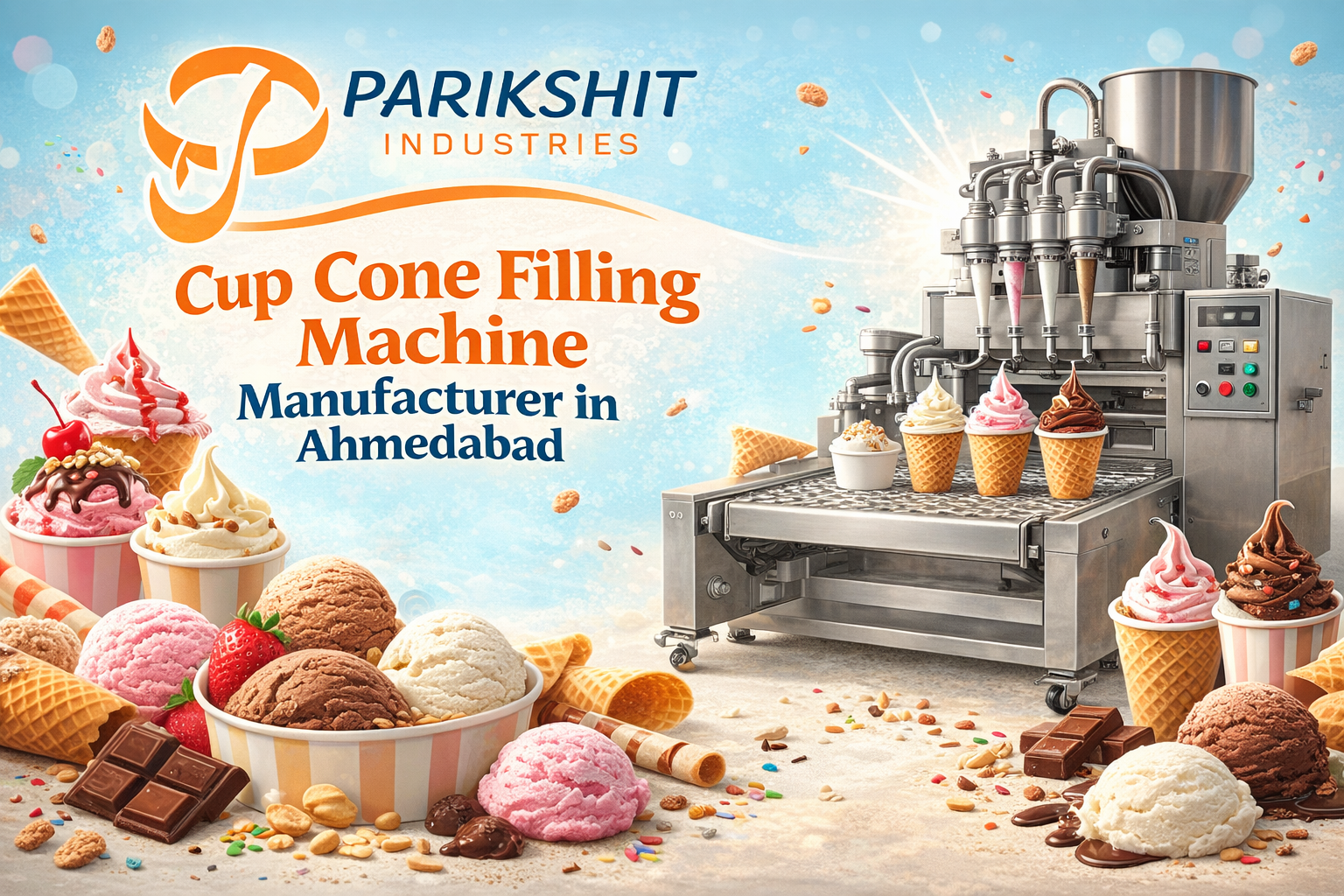
Cup Cone Filling Machine
Manufacturer in Ahmedabad
The ice cream industry in Ahmedabad has experienced steady growth over the past decade, supported by expanding retail demand, organized dairy operations, and increasing consumption across urban and semi-urban markets. In this evolving landscape, efficient and hygienic packaging systems are essential for maintaining product quality and regulatory compliance. A cup cone filling machine manufacturer in Ahmedabad provides practical solutions for accurate and safe filling of ice cream into cups and cones, ensuring production consistency and food safety standards are maintained.
For small and medium-scale ice cream plants, maintaining portion accuracy, minimizing wastage, and improving workflow efficiency are ongoing operational priorities. A well-designed cup and cone filling machine addresses these needs through controlled dispensing, hygienic construction, and simplified cleaning. This type of equipment is particularly valuable for businesses seeking stable and structured production without the complexity of large fully automated systems.
Parikshit Industries
Parikshit Industries is based in Ahmedabad, Gujarat, and operates from an industrial facility in the New Odhav area. The company manufactures ice cream processing equipment and supports small to medium dairy and ice cream businesses. With an emphasis on practical machine design and food-grade construction, the company provides equipment aligned with local industry requirements.
Its product portfolio includes ice cream plant machinery such as batch freezers, continuous ice cream freezers, and cup and cone filling machines. The focus remains on operational reliability, ease of maintenance, and safe food handling practices.
Understanding Cup and Cone Filling Machines
A cup cone filling machine is designed to dispense measured quantities of ice cream into cups or cones with uniformity and minimal spillage. Depending on production capacity and plant layout, the machine may operate in semi-automatic or manual modes.
In a standard production setup, prepared ice cream from a freezer or holding tank is transferred to the filling hopper. The system then dispenses controlled portions into containers positioned under the filling nozzles. The equipment is engineered to promote hygiene, reduce exposure to contaminants, and maintain smooth product flow.
Compared to manual filling, which can result in inconsistent portions and material loss, a dedicated filling machine improves accuracy and repeatability. For commercial brands, consistent product weight is directly linked to customer trust and packaging compliance.
Key Features of Cup Cone Filling Machine
- Accurate and uniform filling quantities
- Hygienic food-grade stainless steel construction
- User-friendly controls for easy operation
- Low power consumption suitable for small plants
- Minimal product wastage during filling
- Flexible configuration for cups and cones
These features make the equipment suitable for businesses that require dependable filling performance without unnecessary automation complexity.
Applications in Ice Cream Production
Cup and cone filling machines are widely used in:
- Ice cream cup filling lines
- Ice cream cone filling operations
- Small and medium-scale ice cream production units
- Pilot plants and startup ice cream businesses
- Seasonal production facilities
Across Ahmedabad and Gujarat, many emerging ice cream brands operate at a medium production scale. For such businesses, maintaining a balance between automation and manual control is important. A semi-automatic filling system provides this balance while improving consistency and output control.
Benefits for Ice Cream Manufacturers
When integrated into a processing line, a cup cone filling machine offers several operational advantages:
- Improves overall production efficiency
- Ensures consistent product quality
- Reduces manual errors during filling
- Minimizes spillage and material wastage
- Supports smoother workflow within the processing line
- Enhances hygiene control during packaging
These benefits contribute directly to operational stability and standardized output across production batches.
Importance of Hygienic Design in Food Equipment
Food-grade construction is a critical requirement in ice cream equipment manufacturing. Stainless steel components, smooth surfaces, and easy-to-clean assemblies help reduce contamination risks and maintain hygiene standards.
In Ahmedabad's climatic conditions, where temperature and humidity can influence storage and handling, hygienic machine design becomes even more significant. A properly engineered filling machine allows operators to clean contact parts efficiently, helping prevent microbial growth and support compliance with food safety guidelines.
Ease of Cleaning and Maintenance
Routine cleaning and preventive maintenance directly influence equipment lifespan and production continuity. A cup cone filling machine designed with accessible components, detachable nozzles, and straightforward control systems reduces downtime and simplifies servicing.
This becomes particularly important during peak production seasons when demand rises sharply. Equipment that is easy to maintain helps avoid interruptions and ensures consistent production output.
Integration with Ice Cream Processing Lines
A cup cone filling machine performs best when integrated with upstream equipment such as batch freezers or continuous ice cream freezers. Proper synchronization ensures stable product flow and consistent texture during filling.
In many compact production facilities in Ahmedabad, available floor space and power capacity are limited. Therefore, machine footprint, energy consumption, and layout flexibility are practical considerations. Manufacturers who design equipment suitable for such plant conditions contribute to efficient workflow planning.
Step-by-Step Cup and Cone Filling Process
A typical cup and cone filling process includes:
- Ice cream preparation in a batch or continuous freezer
- Transfer of ice cream to the filling hopper
- Positioning of cups or cones under the filling nozzle
- Controlled dispensing of the measured quantity
- Optional topping or decoration stage
- Final packaging or sealing
This structured process improves repeatability and reduces dependence on manual estimation.
Choosing the Right Cup Cone Filling Machine in Ahmedabad
Selecting the appropriate machine depends on specific operational requirements. Businesses should assess production capacity, available floor space, power supply, and cleaning needs before making a decision.
A practical buyer checklist includes:
- Required filling capacity per hour
- Compatibility with various cup and cone sizes
- Ease of cleaning and dismantling
- Energy consumption levels
- Availability of service support in Ahmedabad
- Integration capability with existing equipment
Careful evaluation of these factors enables informed investment decisions without oversizing or underutilizing equipment.
Local Manufacturing Advantage
Working with a cup cone filling machine manufacturer in Ahmedabad offers practical advantages. Local manufacturing supports easier installation, faster service response, and a better understanding of regional industry conditions.
Ahmedabad's strong industrial ecosystem, skilled technical workforce, and established supply chains enable manufacturers to provide equipment tailored to the needs of local dairy and ice cream units.
Supporting Small and Medium Ice Cream Plants
Small and medium enterprises represent a significant segment of the ice cream industry in Gujarat. For these businesses, scalable equipment solutions are essential. A cup and cone filling machine provides a structured transition from manual handling to semi-automated production.
As demand grows, businesses can expand output while maintaining consistent portion control. This supports brand reliability and improves overall customer satisfaction.
Operational Efficiency and Waste Reduction
Ice cream is highly temperature-sensitive, and excessive manual handling can lead to melting losses and inconsistent portions. Controlled filling systems reduce exposure time and improve material utilization.
Minimizing wastage not only strengthens cost control but also supports more sustainable plant operations. Efficient equipment design contributes to better raw material management and smoother batch control.
Future OutlookThe ice cream market in Ahmedabad continues to evolve with new product formats and packaging styles. As production volumes increase, structured and hygienic packaging solutions will remain essential.
Cup and cone filling machines will continue to serve as a core component in small and medium processing units. Their ability to deliver consistent, hygienic, and flexible filling performance ensures long-term relevance across different production scales.
A cup cone filling machine manufacturer in Ahmedabad plays an important role in supporting the region's growing ice cream industry.
Through hygienic design, accurate portion control, and dependable performance, this equipment helps small and medium plants maintain consistent product standards. For businesses aiming to streamline production while ensuring food safety and operational efficiency, a well-designed cup and cone filling system offers a structured and reliable solution within the ice cream processing line.
Frequently Asked Questions
A cup cone filling machine is used to fill ice cream into cups and cones with precise portion control. It helps maintain consistency, hygiene, and reduced product wastage during packaging.
Yes, semi-automatic systems are well suited for small and medium plants because they provide controlled filling without complex automation. They offer a practical balance between efficiency and simplicity.
The machine is constructed using food-grade stainless steel components and smooth contact surfaces. These features allow easy cleaning and help reduce contamination risks during production.
Most cup cone filling machines are designed to accommodate varying cup volumes and cone formats. Adjustments can be made based on production requirements.
Businesses should evaluate production capacity, plant layout, ease of cleaning, power consumption, and local service support in Ahmedabad before selecting equipment.
Yes, it is commonly used in pilot plants and startup ice cream units because it improves portion accuracy and production efficiency without requiring large-scale automation.
Get in Touch
Our Blogs
- Vertical Batch Freezer Uses in Dairy Processing
- Gelato Production Machine
- Homogenizer Exporter
- Pasteuriser Uses in Milk Processing
- Pasteuriser Uses in Milk Processing
- Ageing Vat Uses in Dairy Processing
- Pasto Matic Exporter
- Candy Plant Uses in Ice Candy Production
- Fruit Feeder Uses in Ice Cream Production
- Hardening Tunnel Uses in Ice Cream Production
- Hardening Tunnel Uses in Ice Cream Production
- How Fruit Feeder Works
- Ice Cream Machine Manufacturer in Ahmedabad
- Candy Plant Exporter
- Ageing Vat Exporter
- How Cup and Cone Filling Machine Works
- Benefits of Batch Freezer in Ice Cream Making
- Batch Freezer Supplier
- Automatic Cup and Cone Filling Machine Uses
- How Ageing Vat Works
- Ageing Vat Supplier
- Turnkey Ice Cream Plant Manufacturer
- Ice Cream Making Plant Supplier in India
- Ice Cream Machinery Manufacturer in India
- Ice Cream Machinery Manufacturer in Ahmedabad
- Ice Cream Manufacturing Plant Supplier
- Commercial Ice Cream Plant Manufacturer
- Commercial Ice Cream Plant Manufacturer
- Ice Cream Production Plant Manufacturer in Ahmedabad
- Ice Cream Production Plant Manufacturer in Ahmedabad
- Ice Cream Processing Plant Manufacturer in India
- Ice Cream Processing Plant Manufacturer in India
- Industrial Ice Cream Plant Manufacturer
- Ice Cream Machinery Manufacturer in Gujarat
- Ice Cream Factory Equipment Supplier in Gujarat
- Complete Ice Cream Plant Setup in India
- Automatic Cup and Cone Filling Machine for Ice Cream Industry
- Pasteuriser for Dairy Industry
- Ice Cream Processing Plant Manufacture
- Candy Plant Supplier
- Ice Cream Plant Supplier in Gujarat
- Ice Cream Plant Manufacturer in Ahmedabad
- Ice Cream Plant
- Automatic Cup and Cone Filling Machine Exporter
- Candy Plant Manufacturer
- Batch Freezer Manufacturer
- Automatic Cup and Cone Filling Machine Supplier
- Ageing Vat for Ice Cream Industry
- Benefits of Automatic Cup and Cone Filling Machine
- Automatic Cup and Cone Filling Machine
- Ageing Vat Manufacturer
- Ice Cream Plant
- Ice Cream Processing Equipment Manufacturing in India
- Ice Cream Homogenizer Supplier in Gujarat
- Ice Cream Homogenizer Machine Manufacturer in Ahmedabad
- Ice Cream Freezer Machine Near Me
- Ice Cream Freezing System Manufacturing in India
- Ice Cream Freezing Equipment Supplier in Gujarat
- Ice Cream Batch Freezer Manufacturer in Ahmedabad
- Ice Cream Mixer Machine Near Me
- Ice Cream Mixing System Manufacturing in India
- Ice Cream Blending Machine Supplier in Gujarat
- Ice Cream Mixing Machine Manufacturer in Ahmedabad
- Ice Cream Filling Equipment Near Me
- Ice Cream Filling System Manufacturing in India
- Ice Cream Filling Machine Manufacturer in Ahmedabad
- Ice Cream Production Unit Near Me
- Ice Cream Processing Plant Manufacturing in India
- Ice Cream Factory Equipment Supplier in Gujarat
- Ice Cream Production Plant Manufacturer in Ahmedabad
- Ice Cream Equipment Near Me
- Ice Cream Packaging Machine Supplier in India
- Ice Cream Packaging Machine Supplier in Gujarat
- Ice Cream Unit Manufacturing in India
- Ice Cream Production Plant Manufacturer in Ahmedabad
- Ice Cream Plant Manufacturers in India
- Ice Cream Making Machine Manufacturer in Ahmedabad
- Ice Cream Making Plant Supplier in India
- Candy Plant Machine Manufacturing in Gujarat
- Candy Plant Machine Supplier in Ahmedabad
- Candy Plant Manufacturer in India
- Ice Cream Cone Filling Machine Supplier in Gujarat
- Ice Cream Machine Supplier in India
- Continuous Ice Cream Freezer Manufacturing in Ahmedabad
- Candy Plant Machine Supplier in Ahmedabad
- Continuous Ice Cream Freezer Supplier in Ahmedabad
- Ice Cream Plant Manufacturers in Gujarat
- Ice Cream Plant Manufacturing in Gujarat
- Cup Cone Filling Machine Manufacturer in Ahmedabad
- Ice Cream Plant Manufacturer in India
- Ice Cream Plant Manufacturer in India
- Continuous Ice Cream Freezer Manufacturer in India
- Continuous Ice Cream Freezer in Gujarat
- Cup Cone Filling Machine Manufacturer in Ahmedabad
- Ice Cream Machine Manufacturer in Gujarat
- Ice Cream Plant in Ahmedabad, Gujarat
- Ice Cream Plant Supplier in Ahmedabad
- Ice Cream Machine Manufacturer Supplier in Ahmedabad
- Continuous Ice Cream Freezer Manufacturer in Gujarat
- Continuous Ice Cream Freezer in Ahmedabad
- Continuous Ice Cream Freezer in India
- Ice Cream Machinery Manufacturers in India
- Ice Cream Plant Manufacturer Gujarat
- Ice Cream Machine Manufacturer Ahmedabad
- Ice Cream Machine Manufacturers in India
- Ice Cream Machinery Manufacturers in Gujarat
- Ice Cream Machine Manufacturers in Ahmedabad
- Ice Cream Machine Manufacturers in Gujarat
- Ice Cream Machine Manufacturers