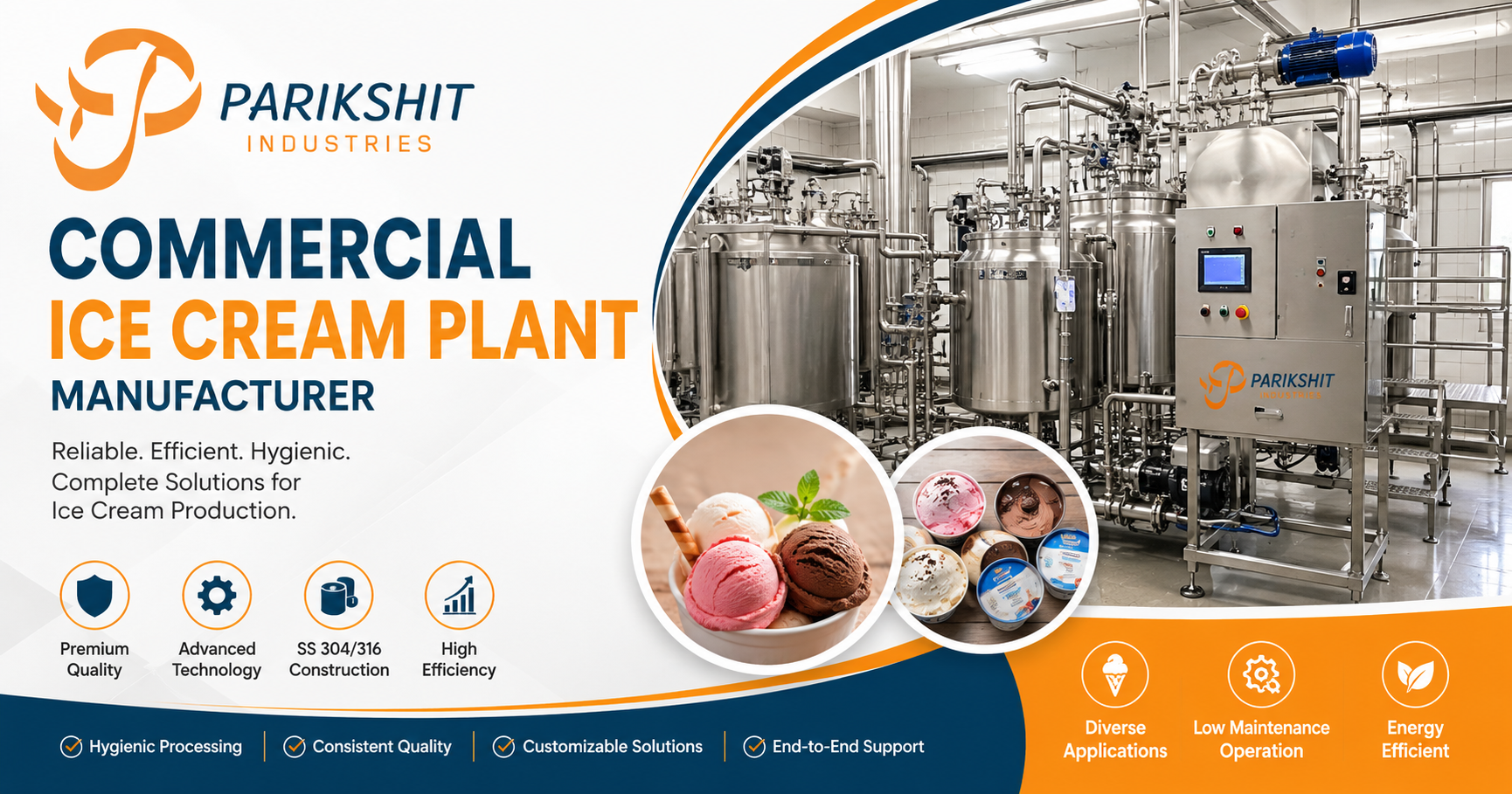
Commercial Ice Cream Plant Manufacturer
Expert commercial ice cream plant manufacturing in Ahmedabad. Parikshit Industries offers reliable, high-quality solutions for your ice cream production needs.
Why This Matters in Ahmedabad
Ahmedabad, a vibrant commercial hub in Gujarat, boasts a dynamic food and beverage industry. With a growing population and a thriving hospitality sector, the demand for locally produced, high-quality ice cream is substantial. Businesses here require robust manufacturing solutions that can meet stringent hygiene standards and deliver consistent output to satisfy consumer tastes. Investing in a well-designed commercial ice cream plant is essential for capitalizing on this market opportunity and ensuring long-term success in the competitive Ahmedabad food landscape.
What is a Commercial Ice Cream Plant — Overview
A commercial ice cream plant is a sophisticated setup designed for the large-scale production of ice cream. It integrates various machinery for mixing ingredients, pasteurizing the mix, homogenizing, aging, freezing, and packaging the final product. These plants are engineered to maintain precise temperature control and hygiene throughout the process, ensuring product safety and quality. From small-scale artisanal producers to large industrial dairies, commercial ice cream plants are the backbone of efficient ice cream manufacturing.
Key Features and Technical Specifications
- Automated Control Systems: PLC-based systems for precise control over temperature, flow rates, and processing times.
- High-Efficiency Freezing: Incorporates advanced refrigeration technology for rapid and uniform freezing, crucial for ice cream texture.
- Durable Stainless Steel Construction: All contact parts are made from food-grade stainless steel (e.g., SS304, SS316) for hygiene and longevity.
- Modular Design: Allows for flexibility in plant layout and scalability to accommodate future production increases.
- Integrated Pasteurization: Ensures the ice cream mix is safely heated and cooled to eliminate harmful bacteria.
- Homogenization Capability: Achieves a smooth, creamy texture by breaking down fat globules.
- Variable Speed Drives: Enables adjustment of processing parameters to suit different product formulations.
- Energy-Efficient Components: Designed to minimize power consumption without compromising performance.
Industrial Applications and Use Cases
- Large-Scale Dairy Operations: Producing a wide range of ice cream products for national distribution.
- Food Processing Companies: Diversifying product lines to include frozen desserts.
- QSR Chains and Hotels: Manufacturing proprietary ice cream flavors for in-house consumption and catering.
- Artisanal Ice Cream Makers: Scaling up production while maintaining unique flavor profiles and quality.
- Contract Manufacturing: Producing ice cream for other brands under private labels.
- Frozen Yogurt and Sorbet Production: Adapting the plant for various frozen dessert formulations.
- Research and Development Facilities: Testing new recipes and production methods.
How to Choose the Right Commercial Ice Cream Plant
Selecting the appropriate commercial ice cream plant requires careful consideration of several factors to ensure it aligns with your business objectives and operational needs.
- Production Capacity: Determine your current and projected daily or hourly output requirements.
- Product Variety: Assess the range of ice cream types (e.g., stick bars, cups, tubs, cones) and formulations you intend to produce.
- Automation Level: Decide on the degree of automation needed, from semi-automatic to fully automated systems.
- Space and Layout: Consider the available floor space and the plant's footprint, including utility requirements.
- Hygiene and Sanitation Standards: Ensure the plant design meets stringent food safety regulations (e.g., HACCP, GMP).
- Energy Efficiency: Evaluate the power consumption of the machinery to manage operational costs.
- Supplier Reputation and Support: Research the manufacturer's track record, customer service, and after-sales support.
- Customization Options: Check if the plant can be tailored to specific needs or future expansion plans.
Quality Standards and Compliance
Adherence to recognized quality standards and compliance with regulatory requirements is paramount in the food processing industry. Commercial ice cream plants must be designed and manufactured to meet stringent hygiene and safety protocols. This typically includes compliance with standards such as ISO 22000 for food safety management, HACCP principles for hazard analysis and critical control points, and GMP (Good Manufacturing Practices). Manufacturers should also ensure their equipment meets relevant national and international standards for electrical safety and material compliance, such as those set by BIS (Bureau of Indian Standards) or IEC (International Electrotechnical Commission). Buyers should always verify that the equipment supplied meets these critical standards to ensure product safety and operational integrity.
Why Parikshit Industries' Experience and Capability Matters
At Parikshit Industries, our extensive experience in designing and manufacturing commercial ice cream plants sets us apart. We understand the nuances of ice cream production, from ingredient handling to final packaging, and translate this knowledge into robust, efficient machinery. Our dedicated team of engineers and technicians possesses deep technical expertise, enabling us to develop customized solutions tailored to your specific production needs and facility constraints. We pride ourselves on a meticulous manufacturing process, rigorous quality control at every stage, and a commitment to delivering reliable equipment.
Our capability extends beyond just manufacturing; we focus on providing end-to-end solutions. This includes offering comprehensive after-sales support, installation guidance, and troubleshooting assistance to ensure your plant operates at peak performance. We work closely with our clients, fostering a collaborative approach to design and implementation, ensuring that the final product not only meets but exceeds expectations for quality, efficiency, and longevity.
Installation, Maintenance, and Care Tips
Proper installation and consistent maintenance are vital for the longevity and optimal performance of your commercial ice cream plant.
- Installation: Ensure the plant is installed on a level, stable surface with adequate access to utilities like power, water, and drainage. Follow the manufacturer's detailed installation manual precisely, paying close attention to electrical connections and refrigerant lines. Professional installation by certified technicians is highly recommended to ensure safety and correct setup.
- Daily Cleaning: After each production run, thoroughly clean all product-contact surfaces. This typically involves flushing with water, followed by a detergent wash and a final rinse. Ensure all cleaning agents are food-grade and approved for use with stainless steel.
- Sanitization: Implement a regular sanitization schedule using approved food-grade sanitizers to eliminate any remaining microbial contaminants.
- Regular Inspections: Periodically inspect all components, including seals, gaskets, valves, and electrical connections, for wear and tear. Replace any damaged parts immediately to prevent production downtime or product contamination.
- Lubrication: Follow the manufacturer's guidelines for lubricating moving parts, using only food-grade lubricants where specified.
- Refrigeration System Checks: Ensure the refrigeration system is functioning correctly, maintaining optimal temperatures. Schedule professional servicing for the refrigeration unit as recommended by the manufacturer.
- Operator Training: Properly train all personnel involved in operating and maintaining the plant. Understanding the equipment's functions and safety procedures is crucial.
Frequently Asked Questions
A commercial ice cream plant, when properly maintained and operated according to manufacturer guidelines, can have a lifespan of 15 to 20 years or even longer. Regular servicing, timely replacement of worn parts, and adherence to cleaning protocols are key to maximizing its operational life and efficiency.
The space requirement varies significantly based on the plant's capacity and the number of integrated units. A small-scale plant might require as little as 500-1000 sq ft, while larger industrial facilities can need several thousand square feet, including space for raw material storage, processing, packaging, and finished goods warehousing.
An ice cream plant requires reliable access to electricity, potable water, and a proper drainage system. Depending on the specific setup, it may also need compressed air, steam for pasteurization, and a suitable area for refrigeration unit installation and ventilation.
Yes, customization is a key aspect of modern ice cream plant manufacturing. Manufacturers can adapt the plant's configuration, freezing capacity, and auxiliary equipment to produce various ice cream products like hard ice cream, soft serve, gelato, sorbets, and frozen yogurt, as well as different packaging formats.
Reputable manufacturers typically offer comprehensive training for your operational staff. This usually covers equipment startup, daily operation procedures, cleaning and sanitation protocols, basic troubleshooting, and safety guidelines to ensure efficient and safe plant management.
The use of high-grade stainless steel (like SS304 or SS316) for all product-contact surfaces is critical. This material is non-reactive, corrosion-resistant, and easy to clean, ensuring product purity and preventing bacterial growth. It also contributes to the plant's durability and longevity in demanding food processing environments.
Conclusion
Establishing or expanding an ice cream production facility in Ahmedabad demands a strategic approach, with the commercial ice cream plant at its core. The right plant is not just a collection of machinery but a carefully engineered system designed for efficiency, hygiene, and consistent quality output. Factors such as production capacity, automation, adherence to quality standards, and the manufacturer's expertise are critical decision points. Partnering with an experienced manufacturer like Parikshit Industries ensures you receive a reliable, customized solution backed by robust engineering and dedicated support, setting your business on the path to success in the competitive frozen dessert market.