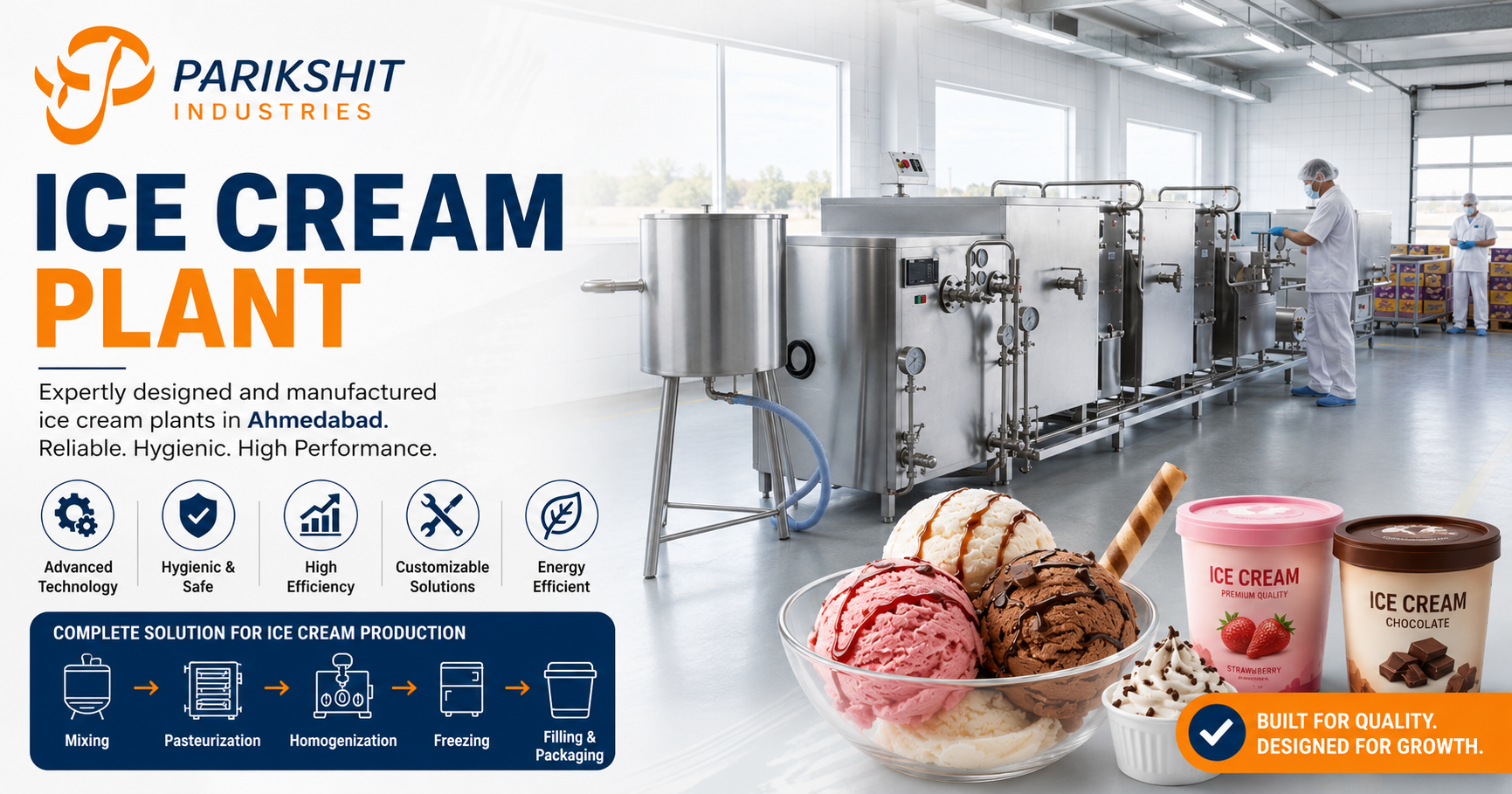
Ice Cream Plant
Expertly designed and manufactured ice cream plants in Ahmedabad. Parikshit Industries offers reliable, high-quality solutions for your dairy processing needs.
What is an Ice Cream Plant? — Overview
An ice cream plant is a comprehensive system of machinery designed for the industrial-scale production of ice cream. It encompasses various stages, from raw ingredient processing and mixing to pasteurization, homogenization, aging, freezing, and finally, filling and packaging. The core of the plant is the freezer, which rapidly chills and aerates the ice cream mix to achieve the desired texture and consistency. These plants are engineered to ensure product safety, consistency, and efficiency in large-scale manufacturing operations.
Key Features and Technical Specifications
When evaluating an ice cream plant, several key features and specifications are paramount for optimal performance and product quality:
- Capacity: Designed to meet specific production volumes, ranging from small batch production to large industrial outputs per hour.
- Materials of Construction: Typically constructed from food-grade stainless steel (e.g., SS304, SS316) for hygiene, durability, and corrosion resistance.
- Freezing Technology: Utilizes advanced refrigeration systems and dasher designs for efficient freezing and incorporation of air (overrun).
- Pasteurization and Homogenization: Integrated or compatible systems to ensure product safety and achieve a smooth, stable emulsion.
- Automated Control Systems: PLC-based controls for precise management of temperature, flow rates, and processing times, ensuring consistency.
- Hygiene and Cleanability: Designed for easy cleaning and sanitization (CIP/SIP capabilities) to meet strict food safety regulations.
- Energy Efficiency: Optimized refrigeration and motor systems to minimize operational costs.
- Customization Options: Ability to tailor plant configurations to specific product types and facility layouts.
Industrial Applications and Use Cases
Ice cream plants are vital for a variety of businesses within the food and dairy sector:
- Large-Scale Dairy Cooperatives: Producing a wide range of ice cream products for national distribution.
- Independent Ice Cream Manufacturers: Focusing on niche markets or premium ice cream brands.
- Food Processing Companies: Diversifying their product portfolio to include frozen desserts.
- Contract Manufacturers: Producing ice cream for other brands under agreement.
- Research and Development Facilities: Testing new formulations and production techniques.
- Frozen Yogurt and Sorbet Producers: Adapting the technology for similar frozen dessert products.
- Supermarket Chains: Operating in-house production facilities for private label ice cream.
How to Choose the Right Ice Cream Plant
Selecting the appropriate ice cream plant involves assessing several critical factors to ensure it aligns with your business objectives and operational needs:
- Production Capacity Requirements: Determine your current and projected daily or hourly output needs.
- Product Variety: Consider the range of ice cream types (e.g., stick bars, cups, tubs, cones) and flavor profiles you intend to produce.
- Available Space and Layout: Assess your facility's footprint and the plant's physical dimensions and configuration requirements.
- Budget and Operational Costs: Evaluate the initial investment against long-term energy consumption, maintenance, and labor costs.
- Automation Level: Decide on the degree of automation required, from semi-automatic to fully automated systems.
- Supplier Reputation and Support: Research the manufacturer's track record, quality certifications, and after-sales service capabilities.
- Compliance and Certifications: Ensure the plant meets relevant food safety standards (e.g., FSSAI, GMP) and industry certifications.
- Customization Needs: Identify any specific features or modifications required for your unique production process.
Quality Standards and Compliance
Adherence to stringent quality standards and regulatory compliance is non-negotiable in the food processing industry. For ice cream plants, this means ensuring that the machinery is built to hygienic design principles and meets national and international food safety regulations. Manufacturers should prioritize equipment that complies with standards such as those set by the Food Safety and Standards Authority of India (FSSAI). Look for plants constructed from food-grade stainless steel, with smooth, crevice-free surfaces that facilitate thorough cleaning and prevent microbial contamination.
Certifications like ISO 9001 for quality management systems are also indicators of a manufacturer's commitment to consistent quality. Furthermore, understanding the specific requirements for pasteurization, refrigeration, and material traceability is essential. A reputable supplier will be transparent about the standards their equipment meets and can provide documentation to verify compliance, giving buyers confidence in the safety and reliability of their investment.
Why Parikshit Industries' Experience and Capability Matters
Parikshit Industries brings a wealth of experience and proven capability to the design and manufacture of ice cream plants. Our deep understanding of dairy processing, combined with robust engineering practices, allows us to deliver solutions tailored to the specific needs of our clients in Ahmedabad and beyond. We focus on precision manufacturing, utilizing high-quality materials and components to ensure the longevity and efficiency of our equipment.
Our team comprises skilled engineers and technicians dedicated to upholding rigorous quality control throughout the production process. This commitment ensures that every ice cream plant leaving our facility is built to perform reliably, meet hygiene standards, and deliver consistent product quality. We pride ourselves on our ability to offer customized solutions, working closely with clients to integrate their specific operational requirements and facility constraints into the plant design. This collaborative approach, backed by our technical expertise, makes Parikshit Industries a trusted partner for your ice cream manufacturing needs.
Installation, Maintenance, and Care Tips
Proper installation, regular maintenance, and diligent care are crucial for the optimal performance and extended lifespan of your ice cream plant. Upon delivery, ensure that installation is carried out by qualified technicians, following the manufacturer's guidelines to guarantee correct setup of refrigeration, electrical, and plumbing connections.
Regular cleaning is paramount. Implement a strict Cleaning-In-Place (CIP) or manual cleaning schedule, using approved food-grade cleaning agents. Pay close attention to seals, valves, and moving parts where residue can accumulate. Routine maintenance should include checking refrigerant levels, lubricating moving components, inspecting electrical connections, and verifying the calibration of temperature and pressure sensors.
Scheduled preventative maintenance, as recommended by the manufacturer, can help identify and address potential issues before they lead to costly downtime or product spoilage. Keep detailed records of all maintenance and cleaning activities. Educating your operational staff on the correct usage and basic troubleshooting of the plant will also contribute significantly to its efficient and reliable operation.
Frequently Asked Questions
With proper installation, regular maintenance, and adherence to operational guidelines, an industrial ice cream plant can have a lifespan of 15 to 20 years or even longer. Key factors influencing longevity include the quality of materials used, the robustness of the design, and the diligence of the maintenance program.
The space requirement varies significantly based on the plant's capacity and the level of automation. A small-scale batch plant might fit within 500-1000 sq ft, while a large-scale continuous production line could require 2000 sq ft or more, including space for ingredient storage, processing, packaging, and finished goods warehousing.
A typical ice cream plant includes ingredient storage and preparation tanks, a pasteurizer, a homogenizer, an aging vat, a continuous or batch freezer, a filling and packaging machine, and a hardening tunnel or freezer. Refrigeration units are also integral to the system.
Yes, customization is a key aspect of industrial ice cream plant design. Manufacturers can tailor the plant to produce various products like stick bars, cups, tubs, or cones, and can adjust freezing parameters to achieve different textures, overrun levels, and inclusions.
Reputable manufacturers typically offer comprehensive training for your operational staff. This training covers safe operation, routine cleaning procedures, basic maintenance, troubleshooting common issues, and understanding the control systems to ensure efficient and correct use of the equipment.
Energy consumption is primarily driven by the refrigeration system and the motors used in the freezers and pumps. The exact requirements depend on the plant's capacity, efficiency of the refrigeration unit, ambient temperature, and the specific processing parameters. Energy-efficient designs can significantly reduce operational costs.
Conclusion
For businesses in Ahmedabad and the wider Gujarat region looking to establish or enhance their ice cream production capabilities, selecting the right ice cream plant is a strategic decision. It requires a thorough understanding of production needs, quality standards, and the technical specifications of the machinery. Parikshit Industries offers experienced engineering and manufacturing expertise, providing reliable, high-quality ice cream plants designed for efficiency and longevity. By focusing on robust construction, hygienic design, and customer-specific solutions, we aim to be your trusted partner in achieving successful and sustainable ice cream manufacturing.