Ice Cream Machine Manufacturer in Gujarat
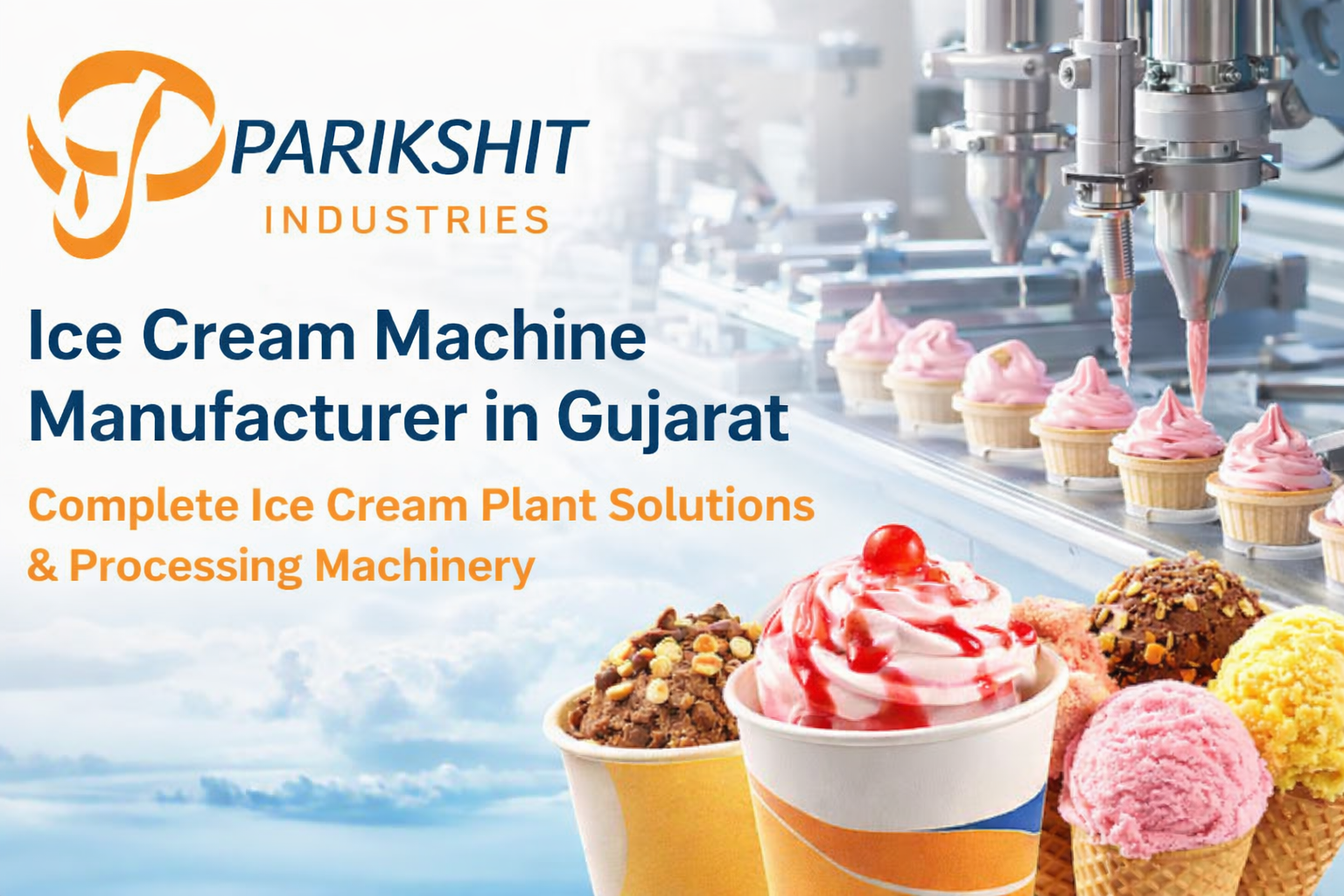
Ice Cream Machine Manufacturer in Gujarat
Parikshit Industries is a specialized ice cream machine manufacturer in Gujarat, engaged in the design and manufacturing of complete ice cream plants and processing machinery for commercial and industrial production. The company works closely with food manufacturers, dairy processors, and ice cream brands that require consistent product quality, hygienic operations, and reliable production performance. With an engineering-driven manufacturing approach and structured project execution, Parikshit Industries supports ice cream production from initial planning through commissioning and long-term operation.
Market Context and Industry Demand
The demand for dependable ice cream processing equipment in Gujarat has grown steadily due to expanding dairy infrastructure, increasing consumption of frozen desserts, and stricter food safety requirements. Manufacturers now seek systems that deliver consistency, scalability, and regulatory compliance rather than isolated machines. This shift has made integrated ice cream plant manufacturing an essential requirement for modern production facilities.
Understanding Industrial Ice Cream Manufacturing Systems
An industrial ice cream plant is a coordinated production system that integrates multiple processes into a continuous and controlled workflow. It is designed to handle high volumes of ice cream mix while maintaining uniform texture, taste, and hygiene. Unlike standalone machines, industrial systems emphasize process stability, automation, and long-term operational efficiency. Ice cream production requires precise control of temperature, pressure, and timing at every stage. Even minor variations can affect product quality and shelf stability. For this reason, manufacturers increasingly prefer complete plant solutions over sourcing individual machines from multiple suppliers.
Role of an Ice Cream Machine Manufacturer in Gujarat
An ice cream machine manufacturer in Gujarat plays a role that extends beyond equipment supply. Manufacturers in this region often serve dairy-based industries operating under varied climatic and operational conditions. Machinery must perform reliably under continuous loads, fluctuating ambient temperatures, and strict hygiene standards. Regional manufacturers also understand local regulatory expectations, utility availability, and space constraints. This knowledge helps in designing plants that are technically robust and practically suited to Indian operating environments. Gujarat's strong industrial ecosystem further supports fabrication quality, thorough testing, and timely delivery of food processing machinery.
Ice Cream Production Process and Integrated Machinery
Industrial ice cream production follows a structured process in which each stage is supported by dedicated machinery. The process begins with mix preparation, where ingredients such as milk, cream, sugar, stabilizers, and flavors are accurately measured and blended. This step is critical for maintaining formulation consistency across batches.
Pasteurization and homogenization follow to ensure food safety and smooth texture. Pasteurization eliminates harmful microorganisms, while homogenization reduces fat globule size to improve creaminess and mouthfeel. These stages require precise control of temperature and pressure to maintain mix quality.
The next phase involves cooling and aging, during which the mix is rapidly cooled and stored in aging tanks for several hours. This resting period allows stabilizers and proteins to hydrate fully, enhancing body and texture. After aging, the mix enters batch or continuous freezers, where freezing occurs along with controlled air incorporation. Inline addition of flavors and inclusions such as fruits or nuts is typically carried out at this stage.
Finally, the ice cream is filled into cups, cones, or sticks and transferred to hardening tunnels or rooms. Hardening at sub-zero temperatures ensures structural stability, improved shelf life, and reduced ice crystal formation.
Importance of Hygienic and Food-Grade Design
Hygiene is a fundamental requirement in ice cream manufacturing. Ice cream plants handle dairy ingredients that are highly sensitive to contamination, making equipment design critical. Machinery must prioritize smooth surfaces, easy cleaning, and the use of food-grade materials. Most industrial systems are manufactured using stainless steel suitable for food contact. Hygienic piping layouts, proper drainage, and controlled airflow help reduce the risk of microbial growth. Automated cleaning systems are often incorporated to ensure consistent sanitation while minimizing downtime. For manufacturers in Gujarat supplying national or export markets, adherence to food safety standards is essential. Well-engineered machinery supports compliance with hygiene audits, traceability requirements, and quality control protocols.
Core Machinery Used in Ice Cream Plants
An industrial ice cream plant consists of multiple machines working together in sequence. Common equipment includes:
- Milk storage tanks for raw material holding
- Pasteurization units for thermal treatment
- Homogenizers for texture consistency
- Aging tanks for controlled resting of the mix
- Ice cream freezers for freezing and aeration
- Filling machines for cups, cones, or sticks
- Hardening tunnels or rooms for final freezing
- Refrigeration systems for temperature control
- Control panels for monitoring and automation
Each machine must integrate seamlessly with the others to avoid bottlenecks and maintain a continuous production flow.
Customization and Capacity Planning
Each ice cream manufacturer operates with distinct production objectives. Some focus on high-volume standard products, while others specialize in items such as kulfi, gelato, or premium inclusion-based ice creams. Capacity planning is therefore a critical aspect of plant design. An experienced ice cream machine manufacturer in Gujarat evaluates daily output targets, product variety, and future expansion plans before recommending machinery configurations. Layout planning also considers available floor space, workflow efficiency, and utility connections. Proper planning helps reduce operational inefficiencies and allows production to scale without major redesign.
End-to-End Ice Cream Plant Solutions
Modern ice cream manufacturers increasingly prefer partners who can deliver end-to-end solutions rather than individual machines. This approach reduces coordination challenges and ensures technical compatibility across the entire plant. End-to-end solutions typically include project consultation, plant layout design, machinery manufacturing, installation, commissioning, and operator training. Ongoing technical support after commissioning helps maintain stable production and address operational issues promptly. This lifecycle-based approach improves long-term plant performance and reliability.
Why Gujarat Is a Key Hub for Ice Cream Machinery Manufacturing
Gujarat has emerged as a significant hub for food processing and dairy equipment manufacturing in India. The state offers strong industrial infrastructure, skilled engineering talent, and proximity to dairy-rich regions. These factors support efficient manufacturing and responsive service. For buyers across India, sourcing from an ice cream machine manufacturer in Gujarat provides logistical advantages and access to engineering teams familiar with local operating conditions. The region's manufacturing ecosystem supports both standardized and customized machinery requirements.
Quality Assurance and Performance Reliability
Quality assurance is central to ice cream machinery manufacturing. Equipment must operate consistently over extended production hours while maintaining product integrity. Testing procedures typically include pressure testing, temperature validation, and trial production runs prior to dispatch. Reliable machinery helps reduce downtime, minimize product losses, and support predictable production scheduling. For manufacturers operating in competitive markets, consistent equipment performance directly influences profitability and brand reliability.
Applications Across Ice Cream Manufacturing Segments
Industrial ice cream plants manufactured in Gujarat are used across a wide range of applications, including:
- Large-scale commercial ice cream production
- Dairy-based frozen dessert manufacturing
- Kulfi and traditional frozen sweets processing
- Cup, cone, and stick ice cream lines
- Contract manufacturing units for private labels
Each application requires specific machine configurations and process controls to meet product and market requirements.
Regulatory Compliance and Operational Safety
Ice cream manufacturing is subject to strict regulatory oversight related to food safety, hygiene, and traceability. Equipment design must support compliance with applicable food processing regulations and internal quality systems. Temperature monitoring, controlled processing parameters, and proper documentation are essential for audits and inspections. Well-designed machinery simplifies compliance by integrating hygienic construction and monitoring systems into the overall plant design.
Conclusion
Selecting the right ice cream machine manufacturer in Gujarat is a critical decision for producers aiming to achieve consistent quality, hygienic operations, and scalable growth. Industrial ice cream plants require precise engineering, integrated systems, and long-term reliability to meet modern production demands. By focusing on process efficiency, food safety, and customization, manufacturers can develop production facilities that support sustainable and compliant ice cream manufacturing across diverse market segments.
Frequently Asked Questions
Our Blogs
- Vertical Batch Freezer Uses in Dairy Processing
- Gelato Production Machine
- Homogenizer Exporter
- Pasteuriser Uses in Milk Processing
- Pasteuriser Uses in Milk Processing
- Ageing Vat Uses in Dairy Processing
- Pasto Matic Exporter
- Candy Plant Uses in Ice Candy Production
- Fruit Feeder Uses in Ice Cream Production
- Hardening Tunnel Uses in Ice Cream Production
- Hardening Tunnel Uses in Ice Cream Production
- How Fruit Feeder Works
- Ice Cream Machine Manufacturer in Ahmedabad
- Candy Plant Exporter
- Ageing Vat Exporter
- How Cup and Cone Filling Machine Works
- Benefits of Batch Freezer in Ice Cream Making
- Batch Freezer Supplier
- Automatic Cup and Cone Filling Machine Uses
- How Ageing Vat Works
- Ageing Vat Supplier
- Turnkey Ice Cream Plant Manufacturer
- Ice Cream Making Plant Supplier in India
- Ice Cream Machinery Manufacturer in India
- Ice Cream Machinery Manufacturer in Ahmedabad
- Ice Cream Manufacturing Plant Supplier
- Commercial Ice Cream Plant Manufacturer
- Commercial Ice Cream Plant Manufacturer
- Ice Cream Production Plant Manufacturer in Ahmedabad
- Ice Cream Production Plant Manufacturer in Ahmedabad
- Ice Cream Processing Plant Manufacturer in India
- Ice Cream Processing Plant Manufacturer in India
- Industrial Ice Cream Plant Manufacturer
- Ice Cream Machinery Manufacturer in Gujarat
- Ice Cream Factory Equipment Supplier in Gujarat
- Complete Ice Cream Plant Setup in India
- Automatic Cup and Cone Filling Machine for Ice Cream Industry
- Pasteuriser for Dairy Industry
- Ice Cream Processing Plant Manufacture
- Candy Plant Supplier
- Ice Cream Plant Supplier in Gujarat
- Ice Cream Plant Manufacturer in Ahmedabad
- Ice Cream Plant
- Automatic Cup and Cone Filling Machine Exporter
- Candy Plant Manufacturer
- Batch Freezer Manufacturer
- Automatic Cup and Cone Filling Machine Supplier
- Ageing Vat for Ice Cream Industry
- Benefits of Automatic Cup and Cone Filling Machine
- Automatic Cup and Cone Filling Machine
- Ageing Vat Manufacturer
- Ice Cream Plant
- Ice Cream Processing Equipment Manufacturing in India
- Ice Cream Homogenizer Supplier in Gujarat
- Ice Cream Homogenizer Machine Manufacturer in Ahmedabad
- Ice Cream Freezer Machine Near Me
- Ice Cream Freezing System Manufacturing in India
- Ice Cream Freezing Equipment Supplier in Gujarat
- Ice Cream Batch Freezer Manufacturer in Ahmedabad
- Ice Cream Mixer Machine Near Me
- Ice Cream Mixing System Manufacturing in India
- Ice Cream Blending Machine Supplier in Gujarat
- Ice Cream Mixing Machine Manufacturer in Ahmedabad
- Ice Cream Filling Equipment Near Me
- Ice Cream Filling System Manufacturing in India
- Ice Cream Filling Machine Manufacturer in Ahmedabad
- Ice Cream Production Unit Near Me
- Ice Cream Processing Plant Manufacturing in India
- Ice Cream Factory Equipment Supplier in Gujarat
- Ice Cream Production Plant Manufacturer in Ahmedabad
- Ice Cream Equipment Near Me
- Ice Cream Packaging Machine Supplier in India
- Ice Cream Packaging Machine Supplier in Gujarat
- Ice Cream Unit Manufacturing in India
- Ice Cream Production Plant Manufacturer in Ahmedabad
- Ice Cream Plant Manufacturers in India
- Ice Cream Making Machine Manufacturer in Ahmedabad
- Ice Cream Making Plant Supplier in India
- Candy Plant Machine Manufacturing in Gujarat
- Candy Plant Machine Supplier in Ahmedabad
- Candy Plant Manufacturer in India
- Ice Cream Cone Filling Machine Supplier in Gujarat
- Ice Cream Machine Supplier in India
- Continuous Ice Cream Freezer Manufacturing in Ahmedabad
- Candy Plant Machine Supplier in Ahmedabad
- Continuous Ice Cream Freezer Supplier in Ahmedabad
- Ice Cream Plant Manufacturers in Gujarat
- Ice Cream Plant Manufacturing in Gujarat
- Cup Cone Filling Machine Manufacturer in Ahmedabad
- Ice Cream Plant Manufacturer in India
- Ice Cream Plant Manufacturer in India
- Continuous Ice Cream Freezer Manufacturer in India
- Continuous Ice Cream Freezer in Gujarat
- Cup Cone Filling Machine Manufacturer in Ahmedabad
- Ice Cream Machine Manufacturer in Gujarat
- Ice Cream Plant in Ahmedabad, Gujarat
- Ice Cream Plant Supplier in Ahmedabad
- Ice Cream Machine Manufacturer Supplier in Ahmedabad
- Continuous Ice Cream Freezer Manufacturer in Gujarat
- Continuous Ice Cream Freezer in Ahmedabad
- Continuous Ice Cream Freezer in India
- Ice Cream Machinery Manufacturers in India
- Ice Cream Plant Manufacturer Gujarat
- Ice Cream Machine Manufacturer Ahmedabad
- Ice Cream Machine Manufacturers in India
- Ice Cream Machinery Manufacturers in Gujarat
- Ice Cream Machine Manufacturers in Ahmedabad
- Ice Cream Machine Manufacturers in Gujarat
- Ice Cream Machine Manufacturers