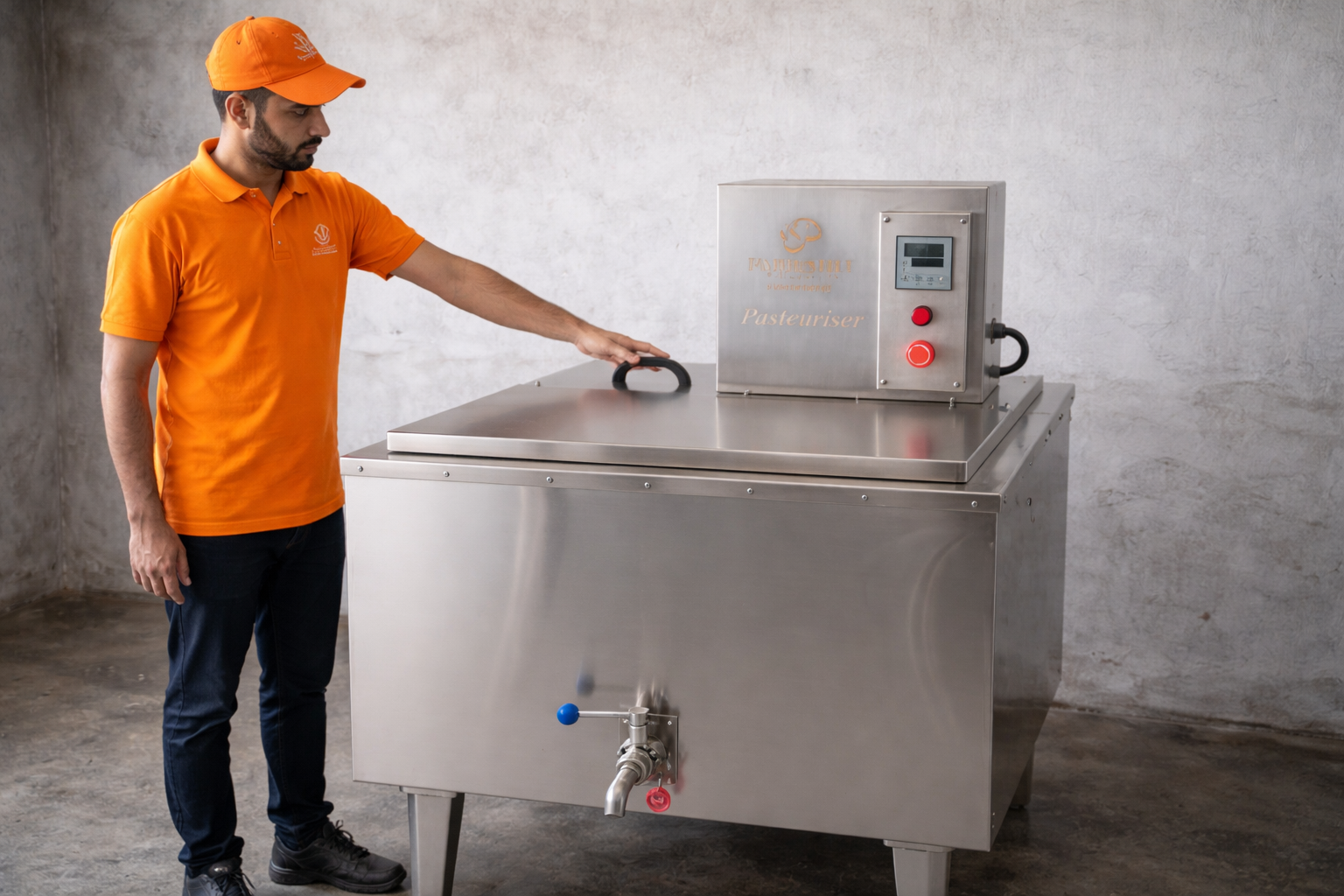
Pasteuriser Manufacturer
In the intricate world of food processing, ensuring the safety, quality, and shelf-life of products hinges on effective thermal treatments. Among the most vital pieces of equipment for achieving these goals is the pasteuriser. A pasteuriser manufacturer plays a crucial role in supplying the technology that safeguards consumable liquids from harmful microorganisms, thereby meeting stringent public health standards and consumer expectations. PARIKSHIT INDUSTRIES stands as a dedicated manufacturer, offering robust pasteurisation solutions designed to meet the diverse needs of the food and dairy sectors, particularly for applications involving milk, cream, ice cream mix, and other beverages.
Understanding the Pasteuriser and Its Function
A pasteuriser is a sophisticated thermal processing system designed to eliminate pathogenic microorganisms present in liquids like milk, juice, beer, and crucially, ice cream mix. This process, named after Louis Pasteur, involves heating the product to a specific temperature for a set duration, followed by rapid cooling. The primary objective is not to sterilize the product but to reduce the number of viable pathogens to levels unlikely to cause disease, significantly extending its shelf life while preserving its nutritional value and sensory characteristics.
Modern pasteurisation systems employ advanced heating technologies, most commonly High Temperature Short Time (HTST) or Low Temperature Long Time (LTLT) methods. These systems typically utilize highly efficient heat exchangers, such as plate or tubular types, to precisely control the heating and cooling cycles. The efficiency of these heat exchangers is paramount for energy conservation and maintaining product integrity, ensuring that the product is heated quickly and cooled rapidly to prevent unwanted changes in taste or texture.
Buyer Insight: Investing in a high-quality pasteuriser is a direct investment in product safety and consumer trust. Understanding the specific thermal processing requirements of your product is key to selecting the right equipment.
The design of contemporary pasteurisers often integrates intelligent control systems that monitor and regulate temperature, flow rates, and holding times. These automated features are essential for consistent performance, ensuring compliance with safety regulations and facilitating traceability through data logging. Many units also come with built-in Clean-In-Place (CIP) systems, simplifying maintenance and ensuring hygienic operations between batches or runs.
Versatile Applications of Pasteuriser Units
The utility of a well-designed pasteuriser extends across a wide spectrum of the food and beverage industry. While universally known for milk processing, their application is far more diverse:
Dairy Products
Essential for milk, cream, yogurt bases, and cheese milk, ensuring safety and extending shelf life. Crucially, it’s vital for preparing safe and stable ice cream mixes.
Ice Cream Mix
Pasteurisation of the ice cream mix is a critical step to kill bacteria and age the mix, influencing the final texture and safety of ice cream.
Juices & Beverages
Used for fruit juices, vegetable juices, and other beverages to eliminate spoilage organisms and pathogens, improving product stability.
Other Food Liquids
Applicable to various other liquid food products where microbial control is necessary for safety and preservation.
Key Benefits of Advanced Pasteurisation Technology
Choosing a modern pasteuriser from a reputable manufacturer brings numerous advantages:
- Enhanced Product Safety: Significantly reduces the risk of foodborne illnesses by eliminating harmful bacteria, yeasts, and molds.
- Extended Shelf Life: Slows down spoilage, allowing products to remain fresh and marketable for longer periods.
- Improved Product Quality: When properly designed, pasteurisation preserves the nutritional content, flavour, and texture of the original product.
- Regulatory Compliance: Meets mandatory food safety standards and regulations required for commercial food production.
- Operational Efficiency: Modern systems offer high heat recovery rates, reducing energy consumption and operating costs.
- Process Control & Traceability: Automated controls and data logging ensure consistent processing and provide records for quality assurance.
Choosing the Right Pasteuriser: A Buyer's Guide
Selecting the appropriate pasteuriser requires careful consideration of several factors. As a dedicated pasteuriser manufacturer, PARIKSHIT INDUSTRIES understands these critical needs. Here’s what buyers should evaluate:
Key Selection Criteria
- Product Type & Volume: Determine the specific product(s) to be processed (milk, juice, ice cream mix) and the required processing capacity (e.g., liters per hour). Different products have unique thermal processing requirements.
- Heating Method: Decide between HTST (for high throughput, efficient) or LTLT (for batch processing or specific product needs) pasteurisation.
- Heat Exchanger Type: Plate heat exchangers are compact and efficient for many applications, while tubular heat exchangers can handle products with higher viscosity or solids content.
- Automation & Control: Assess the level of automation required, including temperature control, flow diversion valves, and data logging capabilities for traceability.
- Hygiene & Cleaning: Look for designs that facilitate easy and effective cleaning, preferably with integrated CIP systems, to maintain stringent hygiene standards.
- Energy Efficiency: Consider systems with high heat recovery rates to minimize operating costs and environmental impact.
- Material Quality: Ensure the unit is constructed from food-grade stainless steel, meeting industry standards for durability and hygiene.
Questions to Ask Before Buying
- What is the recommended pasteurisation temperature and time for my specific product?
- How does the system ensure efficient heat transfer and recovery?
- What level of automation and data logging is included?
- What are the cleaning and maintenance requirements? Are CIP systems integrated?
- What materials are used in construction, and do they meet food-grade standards?
- Can the manufacturer provide support for installation, commissioning, and training?
PARIKSHIT INDUSTRIES: Your Trusted Pasteuriser Manufacturer
PARIKSHIT INDUSTRIES, based in Ahmedabad, Gujarat, India, is dedicated to delivering high-quality food processing machinery, including robust pasteuriser units. With a strong emphasis on quality engineering and customer satisfaction, the company designs and manufactures equipment that adheres to modern food processing standards.
Their approach integrates expertise in optimal design and space utilization, ensuring that clients receive solutions that are both efficient and effective. PARIKSHIT INDUSTRIES prides itself on stringent quality checks at every stage, from material sourcing to the final product, guaranteeing reliability and performance. Their team is equipped to meet challenging market demands, offering tailored solutions to suit specific client requirements for their pasteurisation needs.
Whether you require a pasteuriser for milk, ice cream mix, or other liquid food products, PARIKSHIT INDUSTRIES provides equipment built with precision and a commitment to excellence. They offer comprehensive solutions within their range of Ice Cream Plants and Processing Machinery, aiming to provide unparalleled value and support to their customers.
Frequently Asked Questions About Pasteuriser Units
What is the primary function of a pasteuriser?
The primary function of a pasteuriser is to heat liquid food products like milk and ice cream mix to a specific temperature for a defined time to destroy harmful pathogens, thus ensuring safety and extending shelf life without significantly altering the product's characteristics.
What is the difference between HTST and LTLT pasteurisation?
HTST (High Temperature Short Time) pasteurisation involves heating the product to a higher temperature (e.g., 72°C or 161°F for milk) for a shorter duration (15 seconds). LTLT (Low Temperature Long Time) involves heating to a lower temperature (e.g., 63°C or 145°F for milk) for a longer duration (30 minutes). HTST is common for high-volume continuous processing, while LTLT is often used for smaller batches or specific products.
Can pasteurisers be used for products other than milk?
Yes, pasteurisers are highly versatile and can be used for a wide range of liquid food products, including fruit juices, vegetable juices, beer, wine, and importantly for the ice cream industry, ice cream mixes, cream, and other dairy-based beverages.
Why is pasteurisation important for ice cream production?
For ice cream production, pasteurising the mix is crucial for safety, as it eliminates potential pathogens from raw ingredients like eggs and dairy. It also contributes to the quality by hydrating milk solids, dissolving sugars, and initiating the aging process which improves the texture and whipping properties of the final ice cream.
Ready to Enhance Your Food Processing?
Discover the difference that high-quality, efficiently designed pasteuriser units can make for your business. PARIKSHIT INDUSTRIES offers expertise and reliable machinery to meet your specific needs. Contact us to discuss your requirements and get a tailored solution for your food processing challenges.
Request a Pasteuriser Solution