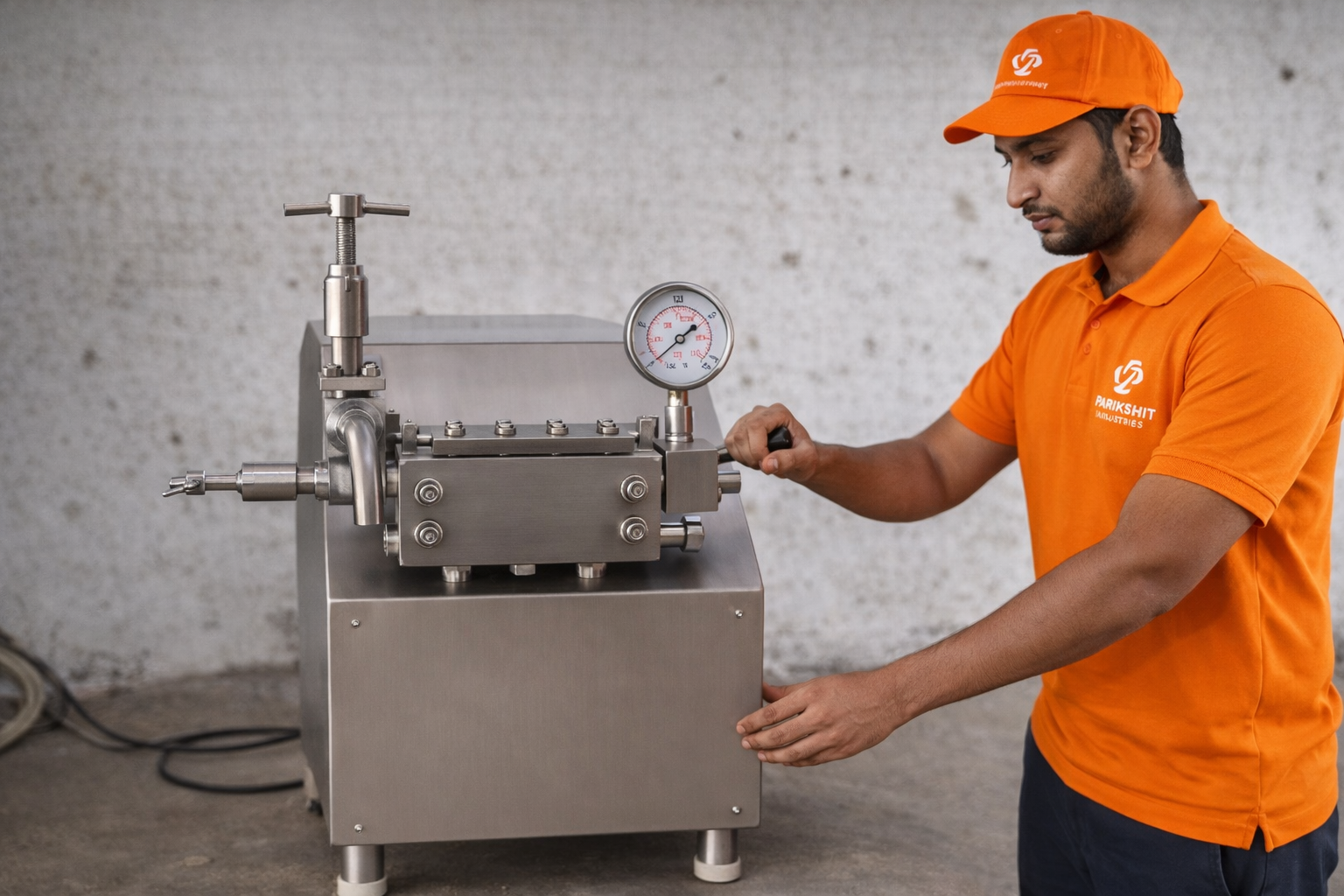
How Homogenizer Works
A homogenizer is a sophisticated piece of machinery crucial for creating stable emulsions and dispersions by reducing particle size and distributing them uniformly. This process is fundamental across numerous industries, from food and beverage to cosmetics and pharmaceuticals, ensuring product quality, consistency, and shelf life. Understanding how a homogenizer works is key to selecting the right equipment for specific manufacturing needs.
Understanding the Homogenization Process
At its core, a homogenizer is designed to achieve a uniform mixture. It operates by forcing a fluid, or a mixture containing suspended particles, through a narrow gap or valve assembly under extremely high pressure. This high-pressure treatment subjects the material to intense mechanical forces, including turbulence, cavitation, and shear. These forces work together to break down larger particles, such as fat globules in milk or solids in a cosmetic cream, into much smaller, uniformly sized droplets. The result is a stable emulsion or dispersion where the dispersed phase remains evenly distributed throughout the continuous phase, preventing separation over time.
The primary mechanism involves a positive displacement pump, typically a piston pump, that draws the product into a chamber and then forces it through a specialized homogenizing valve. This valve is precisely engineered with a small orifice and a seat. As the fluid is squeezed through this confined space at high velocity, it experiences a rapid pressure drop, leading to cavitation (the formation and collapse of tiny vapor bubbles) and intense turbulence. These phenomena create powerful shear forces that effectively reduce particle size and ensure a homogenous mixture.
Key Benefits of Homogenization
The benefits derived from the homogenization process are significant and far-reaching, impacting product quality, stability, and consumer appeal:
Improved Texture and Mouthfeel
By reducing fat globules and creating smaller, uniformly distributed particles, homogenizers significantly enhance the texture of products like ice cream, milk, and sauces, leading to a smoother, creamier mouthfeel.
Enhanced Stability and Shelf Life
Uniform particle distribution prevents gravitational separation of ingredients (like fat rising in milk or solids settling in lotions). This stable emulsion extends the product's shelf life considerably.
Brighter Color and Flavor
Breaking down particles can improve light reflection, leading to a whiter appearance in products like dairy. It also allows for better dispersion of flavors and colorants, creating a more appealing final product.
Increased Yield and Efficiency
In processes like ice cream manufacturing, homogenization can improve overrun and reduce freezing time, leading to higher yields and more efficient production cycles.
No Additives Required
Homogenization is a purely mechanical process that achieves emulsion stability without the need for chemical emulsifiers or stabilizers, aligning with consumer demand for cleaner labels.
Applications Across Industries
The versatility of homogenization makes it indispensable in a wide array of manufacturing sectors:
- Dairy Industry: Essential for milk, cream, yogurt, and ice cream production to ensure consistency, prevent fat separation, and improve texture. Parikshit Industries offers specialized homogenizers for dairy applications as part of their comprehensive processing solutions.
- Food and Beverage: Used in sauces, dressings, beverages, fruit juices, and processed foods to create stable emulsions, improve mouthfeel, and enhance flavor.
- Cosmetics and Personal Care: Crucial for lotions, creams, makeup, and perfumes to achieve smooth, consistent textures and stable emulsions of oils and water-based ingredients. The fine particle size achieved is vital for product feel and efficacy.
- Pharmaceuticals: Employed in the production of pharmaceutical creams, ointments, and suspensions to ensure uniform drug delivery and stability.
- Chemical Industry: Used in producing paints, inks, and coatings where uniform dispersion of pigments and particles is critical for product performance.
Types of Homogenizers
Different applications call for different homogenization technologies. While the fundamental principle of high-pressure processing remains, the specific mechanisms can vary:
Piston Homogenizers
These are the most common industrial homogenizers, utilizing high-pressure piston pumps to force product through a homogenizing valve. They are known for their efficiency and ability to achieve very high pressures, making them suitable for demanding applications like dairy processing. Parikshit Industries provides robust piston homogenizers designed for industrial use.
Rotor-Stator Homogenizers
These operate on a different principle, where a high-speed rotor spins within a stationary stator. The product is drawn into the gap between the rotor and stator, subjected to intense shear forces and turbulence. They are effective for reducing particle size and mixing, often used in cosmetics and smaller-scale food processing.
Ultrasonic Homogenizers
Utilizing high-frequency sound waves, these homogenizers create cavitation in the liquid. The rapid formation and collapse of these cavitation bubbles generate powerful shock waves and micro-jets, leading to intense shear forces that break down particles. They are particularly effective for sensitive materials or applications requiring extremely fine dispersions.
Choosing the Right Homogenizer for Your Needs
Selecting an appropriate homogenizer requires careful consideration of several factors to ensure optimal performance and meet production goals:
Key Selection Criteria:
- Product Type and Viscosity: The nature of the product (e.g., liquid, semi-solid) and its viscosity will dictate the type and pressure requirements of the homogenizer.
- Desired Particle Size Reduction: The degree to which particles need to be reduced determines the homogenization pressure and valve design.
- Capacity and Throughput: Production volume requirements will influence the size and processing capacity of the chosen homogenizer.
- Application Specifics: Whether it's for dairy, food, cosmetics, or pharmaceuticals, the specific industry standards and product sensitivities must be considered.
- Material Compatibility: Ensure the homogenizer is constructed from materials suitable for the product being processed, especially for corrosive or sensitive substances.
- Ease of Cleaning and Maintenance: For hygiene-sensitive industries like food and pharma, ease of cleaning (CIP/SIP capabilities) is paramount.
Parikshit Industries: Your Partner in Processing Solutions
Based in Ahmedabad, Gujarat, India, Parikshit Industries is a specialized manufacturer and supplier of Ice Cream Plants and Processing Machinery. With a comprehensive product range that includes state-of-the-art homogenizers, pasteurizers, ageing vats, and freezers, the company offers end-to-end solutions tailored to the unique needs of the dairy and food processing sectors. Their expertise extends from initial project consultation and plant layout design to manufacturing, installation, commissioning, and dedicated after-sales service, ensuring clients receive complete, reliable processing systems.
Parikshit Industries is committed to delivering quality machinery that enhances product consistency, stability, and overall quality. Their homogenizers are designed for efficiency and durability, playing a vital role in achieving the desired texture and shelf-life for products like ice cream, milk, and other dairy-based goods.
Frequently Asked Questions About Homogenizers
What is the primary function of a homogenizer?
The primary function of a homogenizer is to break down particles in a liquid to a smaller size and distribute them uniformly throughout the mixture, creating a stable emulsion or dispersion.
How does homogenization affect ice cream?
In ice cream, homogenization breaks down fat globules and distributes them evenly. This leads to a smoother texture, improved body, richer mouthfeel, better whipping properties, and increased resistance to heat shock, ultimately enhancing the overall quality and shelf life.
Is homogenization a chemical or mechanical process?
Homogenization is a purely mechanical process. It uses physical forces like high pressure, turbulence, and cavitation to achieve particle size reduction and uniform distribution, without the need for chemical additives.
What is the difference between a homogenizer and a mixer?
While both are used for blending, a homogenizer subjects the mixture to extremely high pressure and mechanical forces to achieve sub-micron particle sizes and stable emulsions. A standard mixer typically operates at lower speeds and pressures, primarily for bulk mixing rather than fine particle dispersion and emulsion stabilization.
Ready to Enhance Your Product Quality?
Invest in a high-performance homogenizer from Parikshit Industries to achieve superior product texture, stability, and shelf life. Explore our range of processing machinery and benefit from our end-to-end solutions. Contact us today to discuss your specific requirements and find the perfect equipment for your production needs.