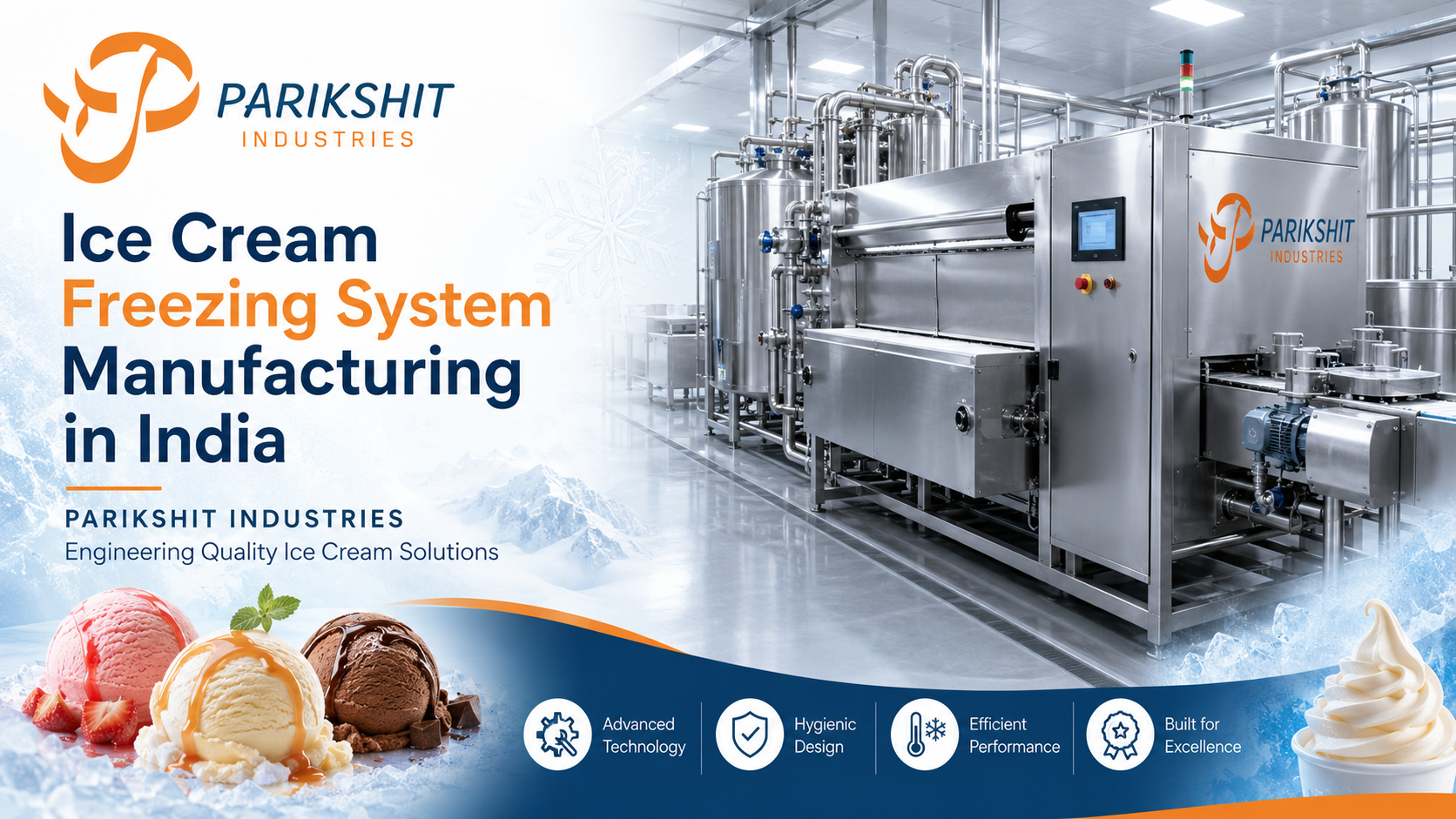
Ice Cream Freezing System Manufacturing in India
Ice cream freezing system manufacturing in India plays an important role in the dairy and frozen dessert industry. As the demand for ice cream, frozen desserts, kulfi, gelato, softy mixes, and value-added dairy products continues to grow, manufacturers need reliable freezing systems that support consistent texture, controlled temperature, stable output, and hygienic processing. A properly designed freezing system is not only a machine; it is an essential part of the complete ice cream production process.
In India, ice cream production is carried out by small dairy units, medium-scale manufacturers, regional brands, and large processing plants. Each business has different production requirements, but the core need remains the same: the freezing system must deliver smooth product consistency, proper overrun, efficient cooling, and dependable performance. This makes selecting the right ice cream freezing system manufacturer an important decision for businesses planning to start, expand, or upgrade their production facility.
Parikshit Industries: Ahmedabad, Gujarat
Parikshit Industries is based in Ahmedabad, Gujarat, and is engaged in the design, manufacture, and supply of ice cream plants and processing machinery. The company works with products such as ice cream plants, continuous ice cream freezers, batch freezers, and related machinery used in ice cream production. With a focus on engineering quality, production support, and food processing requirements, Parikshit Industries serves businesses looking for practical ice cream manufacturing solutions in India.
Understanding Ice Cream Freezing Systems
An ice cream freezing system is used to freeze ice cream mix under controlled conditions while incorporating air and developing the desired texture. The freezing stage is one of the most important steps in ice cream manufacturing because it directly affects mouthfeel, body, smoothness, melting resistance, and final product stability.
Before the mix enters the freezing system, it usually goes through preparation, pasteurization, homogenization, ageing, and flavor mixing. Once the mix is properly prepared, the freezing system cools it rapidly and converts it into semi-frozen ice cream. Depending on production capacity and process requirements, manufacturers may use continuous ice cream freezers, batch freezers, or complete plant systems.
The purpose of the system is not only to reduce temperature but also to maintain product uniformity. A good freezing system helps prevent large ice crystal formation, supports controlled air incorporation, and ensures the final product has a smooth and consistent structure. This makes the freezing system a critical investment for any ice cream production unit.
Importance of Ice Cream Freezing System Manufacturing in India
India has a growing dairy processing and frozen dessert market, supported by urban demand, seasonal consumption, food service expansion, retail distribution, and the rise of regional ice cream brands. As production volumes increase, businesses require machinery that can handle Indian working conditions, varied batch sizes, and different product formulations.
Ice cream freezing system manufacturing in India helps local businesses access machinery suitable for their production scale, space availability, utility setup, and operational needs. Indian manufacturers understand the requirements of dairy units, food processing companies, and small entrepreneurs because they work closely with local production environments.
Service support is another important factor. Machinery used in food processing requires installation guidance, technical assistance, spare parts, and maintenance support. When businesses choose a manufacturer in India, communication and after-sales coordination become easier. This is useful for production teams that need quick support during installation, operation, or routine servicing.
How an Ice Cream Freezing System Works
The working process of an ice cream freezing system depends on the type of machine and production method. However, the basic function remains focused on freezing, mixing, air incorporation, and product discharge.
In a continuous ice cream freezer, the prepared ice cream mix is fed into a freezing cylinder. Inside the cylinder, the mix is cooled with the help of a refrigeration system while a dasher or scraper assembly continuously agitates the product. This movement prevents large ice crystals from forming and helps achieve a smooth texture. Air may also be incorporated into the mix to create the required overrun.
In a batch freezer, a fixed quantity of ice cream mix is processed at one time. The operator loads the mix into the freezing chamber, where it is chilled and agitated until it reaches the required semi-frozen consistency. Batch freezers are commonly used for smaller production, specialty flavors, trial batches, or units where flexibility is more important than continuous output.
Key Components of an Ice Cream Freezing System
- Freezing cylinder for controlled cooling of the ice cream mix
- Dasher or scraper assembly for continuous movement and smooth texture
- Refrigeration unit for temperature reduction
- Mix feeding system for controlled product input
- Air incorporation arrangement where required
- Product outlet for semi-frozen ice cream discharge
- Control panel for machine operation and monitoring
- Food-grade contact parts for hygienic processing
- Frame and body structure for machine stability
- Cleaning access points for routine sanitation
Types of Ice Cream Freezing Systems Used in India
Continuous ice cream freezers are suitable for businesses that need regular production with consistent output. These systems are commonly used by manufacturers producing packaged ice cream, cups, cones, bricks, tubs, and bulk products. They are designed for continuous operation and help maintain uniform texture across production runs.
Batch freezers are useful for small and medium-scale production, product trials, premium batches, and flavor flexibility. They allow manufacturers to produce different flavors in controlled batches without requiring a fully continuous setup. This makes them practical for startups, parlors, boutique ice cream brands, and regional producers.
Complete ice cream plants include multiple processing stages such as mix preparation, pasteurization, ageing, freezing, filling, and storage support. Businesses planning structured production often prefer plant-based solutions because they provide an organized workflow and better process control.
Applications of Ice Cream Freezing Systems
- Ice cream production for cups, cones, bricks, and tubs
- Frozen dessert manufacturing for retail and food service supply
- Kulfi and dairy-based frozen product preparation
- Gelato and premium ice cream production
- Small batch flavor development and product testing
- Commercial dairy processing units
- Ice cream parlors with in-house production
- Regional ice cream brands and distributors
- Institutional and catering supply units
- Food processing startups entering frozen desserts
Benefits of a Properly Designed Ice Cream Freezing System
- Consistent texture across production batches
- Better control over freezing temperature and product body
- Reduced chances of large ice crystal formation
- Improved production efficiency for commercial output
- Hygienic processing with suitable food-contact materials
- Flexible options for different production capacities
- Smooth product handling and discharge
- Better workflow when integrated with complete ice cream plants
- Long-term usefulness for business expansion
Ice Cream Freezing System Manufacturer Selection Guide
Choosing the right ice cream freezing system manufacturer in India requires more than comparing machine capacity. Buyers should evaluate the complete manufacturing approach, technical understanding, machine design, service support, and suitability for their production needs.
- Experience in ice cream plant and freezing machinery manufacturing
- Availability of continuous freezer, batch freezer, and plant solutions
- Machine design suitable for food processing environments
- Quality of contact parts and hygienic construction
- Support for installation and operator guidance
- Availability of spare parts and service assistance
- Ability to suggest suitable capacity based on production plans
Quality and Hygiene in Ice Cream Freezing Systems
Food processing machinery must be designed with hygiene and operational safety in mind. Ice cream is a dairy-based product, and its production requires clean handling, proper sanitation, and controlled processing. The freezing system should allow easy cleaning and should be built using suitable materials for product contact areas.
Quality assurance in ice cream freezing systems includes checking fabrication quality, mechanical alignment, refrigeration performance, electrical control, and product-contact finishing. Proper testing before dispatch helps reduce operational issues during installation and production.
Maintenance and Operational Considerations
Regular maintenance helps keep an ice cream freezing system efficient and reliable. Operators should follow recommended cleaning schedules, lubrication requirements, inspection routines, and safety practices. Since ice cream contains dairy solids, sugar, fats, and flavors, proper cleaning after production is essential.
- Cleaning product-contact parts after production
- Checking refrigeration performance regularly
- Inspecting scraper or dasher assembly for wear
- Monitoring electrical panel and controls
- Ensuring proper lubrication where required