Ice Cream Homogenizer Supplier in Gujarat
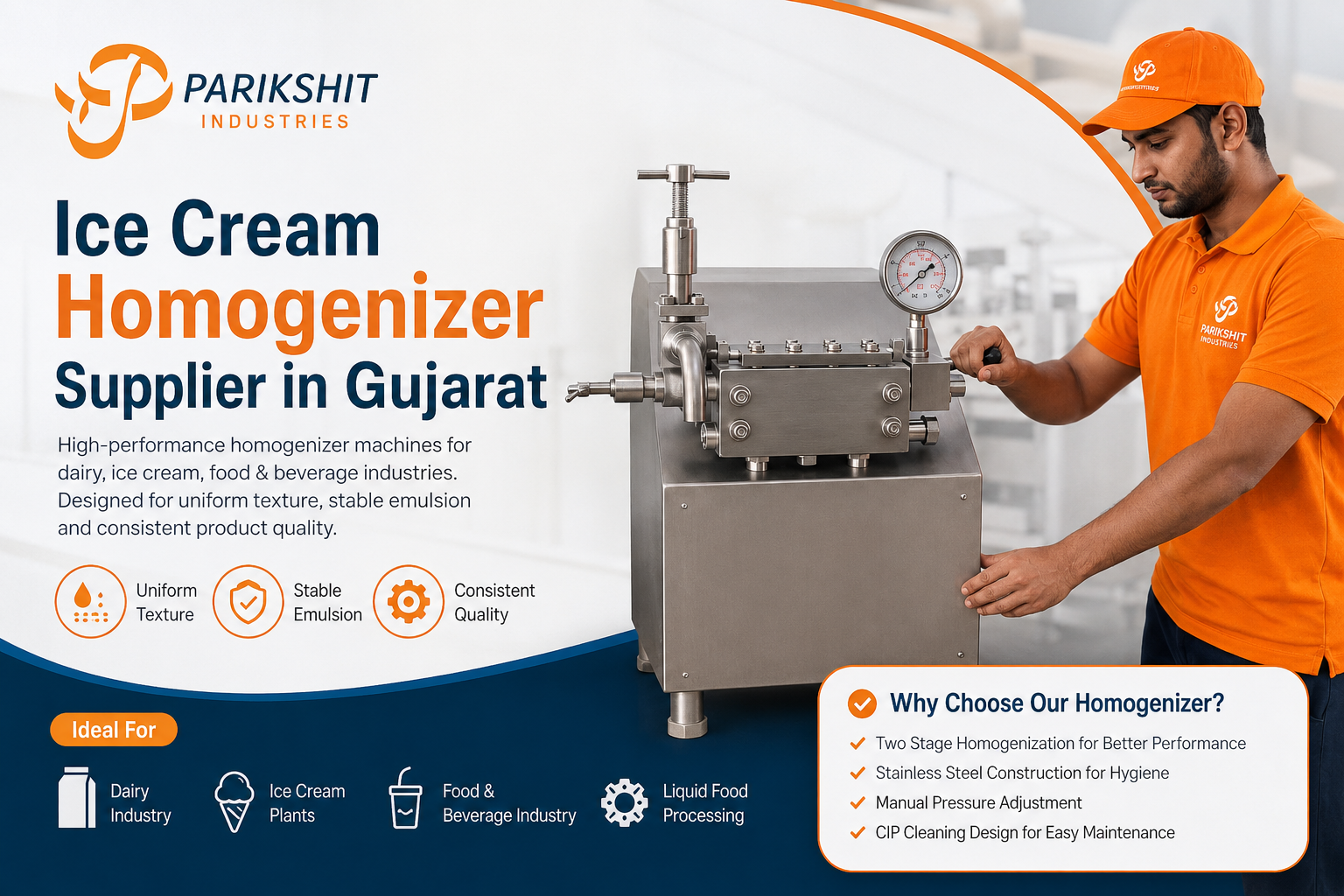
Ice Cream Homogenizer Supplier in Gujarat
An Ice Cream Homogenizer Supplier in Gujarat plays an important role in supporting dairy plants, ice cream manufacturers, food processing units, and beverage production facilities that require smooth, stable, and consistent liquid processing. In ice cream production, texture, uniformity, mouthfeel, and product stability depend greatly on proper homogenization. A homogenizer machine helps reduce the particle size of milk fat and other ingredients so the final product remains smooth, well-blended, and visually consistent.
Parikshit Industries supplies homogenizer machines used in dairy, ice cream, food, and beverage applications. The company provides equipment designed for particle size reduction, emulsification, and uniform dispersion of solids or liquids within a liquid medium. With stainless steel covering panels, two-stage homogenization, manual pressure adjustment, sanitary pressure gauges, and CIP-friendly design, the homogenizer supports practical use in industrial processing environments.
For ice cream manufacturers in Gujarat, a homogenizer is not just a supporting machine. It directly affects product quality, shelf stability, creaminess, whiteness, viscosity, and consistency. When milk or ice cream mix is processed under high pressure, fat globules are broken into smaller particles, helping prevent cream separation and improving the overall structure of the mix. This makes homogenization an essential step in professional ice cream production.
Understanding Ice Cream Homogenizer Machine
An ice cream homogenizer machine is used to reduce the particle size of milk and other liquid ingredients used in ice cream manufacturing. In raw milk or dairy-based liquid mixtures, fat naturally tends to rise and form a cream layer when left undisturbed. This uneven separation can affect texture, consistency, appearance, and taste. Homogenization helps solve this issue by breaking down fat globules and dispersing them evenly throughout the liquid.
The process works by passing the liquid through a high-pressure system. Inside the homogenizer, the product moves through a piston pump and homogenizing valve, where pressure forces the liquid through a narrow opening. This action reduces particle size and increases particle surface area. As a result, fat globules and other particles are distributed more uniformly in the mix.
In ice cream production, this process improves smoothness and stability. A well-homogenized mix supports better freezing performance, improved body, uniform texture, and controlled viscosity. It also helps enhance the whiteness of dairy products and reduces the chance of cream separation during storage or processing.
Why Homogenization Matters in Ice Cream Production
Ice cream quality depends on the right balance of fat, milk solids, stabilizers, sugar, water, and flavouring ingredients. If these components are not properly mixed and stabilized, the final product may show defects such as poor texture, uneven consistency, weak body, cream separation, or unstable structure. Homogenization helps improve this balance by converting the mixture into a fine and stable emulsion.
For dairy-based ice cream, milk fat plays a major role in smoothness and mouthfeel. When fat particles remain large, the mix may not freeze properly or may produce a grainy texture. A homogenizer reduces fat globule size and distributes them evenly, helping create a smoother product with better eating quality.
Homogenization also supports better ingredient interaction. Stabilizers, emulsifiers, milk solids, and liquid components work more effectively when particle distribution is uniform. This improves product stability during freezing, storage, transportation, and serving. For commercial ice cream production, consistency from batch to batch is important, and homogenization supports this requirement.
Key Features of Homogenizer Machine
A well-designed homogenizer machine should be built for continuous processing, hygienic handling, stable pressure control, and easy operation. The machine offered for dairy and ice cream applications includes features that support practical production needs.
- Capacity options of 200, 300, 500, and 1000 LPH
- Stainless steel covering panel for hygienic processing areas
- Two-stage homogenization for improved particle reduction
- Manual pressure adjustment using hand wheel
- S.S. diaphragm-type sanitary pressure gauge
- High-strength eccentric shaft and connecting rod assembly
- Splash lubricating system for smooth mechanical operation
- CIP cleaning-friendly design for easier cleaning support
- Electric motor-driven piston pump operation
- Suitable design for dairy, ice cream, food, and beverage processing
These features make the machine useful for manufacturers who require controlled homogenization and stable processing results. Stainless steel construction supports hygiene, while two-stage homogenization helps achieve better product uniformity.
Two-Stage Homogenization and Its Importance
Two-stage homogenization is useful in dairy and ice cream processing because it improves the stability of fat globules after the first pressure stage. In the first stage, the liquid is passed through high pressure to reduce particle size. In the second stage, clusters or agglomerates are further broken down to improve dispersion and prevent fat particles from rejoining.
This process is especially important for ice cream mix because the final product needs a balanced structure. If the mix is not properly homogenized, fat particles may clump together, affecting smoothness and stability. Two-stage homogenization supports better emulsion control, improved viscosity, and more uniform product quality.
For ice cream plants in Gujarat, where production volumes and product varieties may vary, two-stage homogenization helps maintain dependable quality across different batches. It also supports the processing of milk, cream-based mixes, flavoured dairy products, and other liquid food formulations.
Applications in Dairy and Ice Cream Industry
The homogenizer machine is widely used in dairy and ice cream production because it improves several important product qualities. It helps manufacturers achieve a stable, smooth, and uniform product while reducing separation issues.
- Ice cream mix preparation
- Milk homogenization
- Flavoured milk processing
- Dairy beverage production
- Cream-based product processing
- Liquid dessert manufacturing
- Yogurt and fermented dairy preparation
- Dairy emulsion stabilization
- Ice cream plant processing lines
- Small and medium dairy production units
In the ice cream industry, homogenization helps create smoothness, improve product stability, avoid cream layer formation, reduce curd tension, increase viscosity, and enhance whiteness. These results directly support better product consistency and customer acceptance.
Applications in Food and Beverage Industry
Apart from dairy and ice cream, homogenizer machines are also used in food and beverage applications where uniform mixing, stable texture, and improved appearance are important. Many liquid food products require emulsification or dispersion to prevent separation and maintain consistent quality.
- Fruit beverage processing
- Pulp-based drink stabilization
- Sauce and dressing preparation
- Emulsion-based food products
- Liquid food blending
- Beverage appearance improvement
- Colour and flavour consistency
- Pulp stabilization to required consistency
- Ring formation prevention in bottled drinks
- Food product texture improvement
In food and beverage processing, homogenization helps improve appearance, colour, and flavour. It also improves emulsification properties and stabilizes pulp to the desired consistency, making it useful for manufacturers working with different liquid formulations.
Technical Specification of Ice Cream Homogenizer
The homogenizer machine is available in multiple capacity models to suit different production requirements. Selection depends on required output, pressure level, motor capacity, and processing application.
- Model options: 200, 300, 500, and 1000
- Capacity: 200 LPH, 300 LPH, 500 LPH, and 1000 LPH
- Motor power: 3 HP, 3 HP, 5 HP, and 10 HP
- Maximum working pressure: 2500 PSI, 2500 PSI, 3000 PSI, and 3500 PSI
- Number of pistons: 3
- Operation type: Manual
These specifications support dairy and ice cream manufacturers with different production scales. Smaller capacity models may suit compact production setups, while higher capacity models support larger processing requirements.
Benefits of Using Homogenizer in Ice Cream Manufacturing
A homogenizer improves both processing quality and final product performance. Its role becomes especially important when manufacturers need repeatable results in texture, stability, and product appearance.
- Helps create smoother ice cream texture
- Reduces fat particle size for uniform dispersion
- Prevents cream layer formation in dairy mixes
- Improves viscosity and product body
- Supports stable emulsion formation
- Enhances whiteness and visual appeal
- Improves flavour distribution in the mix
- Supports consistent batch quality
- Helps reduce separation during storage
- Improves processing reliability for dairy plants
These benefits make homogenization a key stage in professional ice cream manufacturing. It supports better product quality without depending only on manual mixing or basic blending.
Demand for Ice Cream Homogenizer in Gujarat
Gujarat has a strong base of dairy, food processing, beverage, and ice cream manufacturing businesses. Many production units require dependable equipment that can support hygienic processing, efficient operation, and consistent output. As consumer demand for quality dairy and frozen products increases, manufacturers focus more on processing systems that improve texture, stability, and shelf performance.
An Ice Cream Homogenizer Supplier in Gujarat helps local manufacturers access equipment suitable for milk processing, ice cream mix preparation, and food liquid stabilization. Local availability also supports easier communication, technical understanding, and faster coordination for machinery selection.
For businesses involved in ice cream production, homogenizer selection should be based on capacity, pressure requirement, product type, cleaning method, and expected production volume. A properly selected homogenizer can support smoother processing and better quality control.
How to Choose the Right Homogenizer Machine
Choosing the right homogenizer requires a clear understanding of the production process and the type of product being manufactured. A machine suitable for small-scale dairy processing may not meet higher production requirements. Similarly, pressure capacity and motor power should match the nature of the liquid mix.
- Check required production capacity in LPH
- Select pressure range based on product formulation
- Consider two-stage homogenization for better stability
- Prefer stainless steel construction for hygienic use
- Review cleaning support such as CIP-friendly design
- Check motor capacity and mechanical strength
- Ensure sanitary pressure gauge and safe operation
- Match machine size with plant layout
- Consider future production expansion
- Choose equipment suitable for dairy and food applications
This checklist helps buyers select a homogenizer that fits both current and future processing needs.
Maintenance and Cleaning Considerations
In dairy and ice cream processing, hygiene and maintenance are critical. A homogenizer handles milk and food-grade liquids, so cleaning should be systematic and regular. CIP-friendly design helps simplify cleaning because it supports internal cleaning without unnecessary dismantling. Proper cleaning reduces contamination risk and supports better equipment life.
Regular maintenance should include checking pressure gauges, lubrication systems, piston assembly, valves, seals, and motor performance. Since the homogenizer operates under high pressure, operators should follow safe handling practices and avoid running the machine outside recommended limits. Clean operation, correct pressure adjustment, and timely maintenance help ensure stable machine performance.
Conclusion
An Ice Cream Homogenizer Supplier in Gujarat supports dairy and ice cream manufacturers with equipment that improves product texture, stability, consistency, and processing reliability. Homogenization is an essential step in ice cream production because it reduces fat particle size, prevents cream separation, improves viscosity, and helps create a smooth final product.
Parikshit Industries provides homogenizer machines suitable for dairy, ice cream, food, and beverage applications. With multiple capacity options, stainless steel covering panels, two-stage homogenization, manual pressure adjustment, sanitary pressure gauge, and CIP-friendly design, the machine supports practical processing needs for manufacturers. For businesses focused on consistent ice cream quality, selecting the right homogenizer can improve both production control and final product performance.
FAQs
Relevant SEO Tags
Our Blogs
- Vertical Batch Freezer Uses in Dairy Processing
- Gelato Production Machine
- Homogenizer Exporter
- Pasteuriser Uses in Milk Processing
- Pasteuriser Uses in Milk Processing
- Ageing Vat Uses in Dairy Processing
- Pasto Matic Exporter
- Candy Plant Uses in Ice Candy Production
- Fruit Feeder Uses in Ice Cream Production
- Hardening Tunnel Uses in Ice Cream Production
- Hardening Tunnel Uses in Ice Cream Production
- How Fruit Feeder Works
- Ice Cream Machine Manufacturer in Ahmedabad
- Candy Plant Exporter
- Ageing Vat Exporter
- How Cup and Cone Filling Machine Works
- Benefits of Batch Freezer in Ice Cream Making
- Batch Freezer Supplier
- Automatic Cup and Cone Filling Machine Uses
- How Ageing Vat Works
- Ageing Vat Supplier
- Turnkey Ice Cream Plant Manufacturer
- Ice Cream Making Plant Supplier in India
- Ice Cream Machinery Manufacturer in India
- Ice Cream Machinery Manufacturer in Ahmedabad
- Ice Cream Manufacturing Plant Supplier
- Commercial Ice Cream Plant Manufacturer
- Commercial Ice Cream Plant Manufacturer
- Ice Cream Production Plant Manufacturer in Ahmedabad
- Ice Cream Production Plant Manufacturer in Ahmedabad
- Ice Cream Processing Plant Manufacturer in India
- Ice Cream Processing Plant Manufacturer in India
- Industrial Ice Cream Plant Manufacturer
- Ice Cream Machinery Manufacturer in Gujarat
- Ice Cream Factory Equipment Supplier in Gujarat
- Complete Ice Cream Plant Setup in India
- Automatic Cup and Cone Filling Machine for Ice Cream Industry
- Pasteuriser for Dairy Industry
- Ice Cream Processing Plant Manufacture
- Candy Plant Supplier
- Ice Cream Plant Supplier in Gujarat
- Ice Cream Plant Manufacturer in Ahmedabad
- Ice Cream Plant
- Automatic Cup and Cone Filling Machine Exporter
- Candy Plant Manufacturer
- Batch Freezer Manufacturer
- Automatic Cup and Cone Filling Machine Supplier
- Ageing Vat for Ice Cream Industry
- Benefits of Automatic Cup and Cone Filling Machine
- Automatic Cup and Cone Filling Machine
- Ageing Vat Manufacturer
- Ice Cream Plant
- Ice Cream Processing Equipment Manufacturing in India
- Ice Cream Homogenizer Supplier in Gujarat
- Ice Cream Homogenizer Machine Manufacturer in Ahmedabad
- Ice Cream Freezer Machine Near Me
- Ice Cream Freezing System Manufacturing in India
- Ice Cream Freezing Equipment Supplier in Gujarat
- Ice Cream Batch Freezer Manufacturer in Ahmedabad
- Ice Cream Mixer Machine Near Me
- Ice Cream Mixing System Manufacturing in India
- Ice Cream Blending Machine Supplier in Gujarat
- Ice Cream Mixing Machine Manufacturer in Ahmedabad
- Ice Cream Filling Equipment Near Me
- Ice Cream Filling System Manufacturing in India
- Ice Cream Filling Machine Manufacturer in Ahmedabad
- Ice Cream Production Unit Near Me
- Ice Cream Processing Plant Manufacturing in India
- Ice Cream Factory Equipment Supplier in Gujarat
- Ice Cream Production Plant Manufacturer in Ahmedabad
- Ice Cream Equipment Near Me
- Ice Cream Packaging Machine Supplier in India
- Ice Cream Packaging Machine Supplier in Gujarat
- Ice Cream Unit Manufacturing in India
- Ice Cream Production Plant Manufacturer in Ahmedabad
- Ice Cream Plant Manufacturers in India
- Ice Cream Making Machine Manufacturer in Ahmedabad
- Ice Cream Making Plant Supplier in India
- Candy Plant Machine Manufacturing in Gujarat
- Candy Plant Machine Supplier in Ahmedabad
- Candy Plant Manufacturer in India
- Ice Cream Cone Filling Machine Supplier in Gujarat
- Ice Cream Machine Supplier in India
- Continuous Ice Cream Freezer Manufacturing in Ahmedabad
- Candy Plant Machine Supplier in Ahmedabad
- Continuous Ice Cream Freezer Supplier in Ahmedabad
- Ice Cream Plant Manufacturers in Gujarat
- Ice Cream Plant Manufacturing in Gujarat
- Cup Cone Filling Machine Manufacturer in Ahmedabad
- Ice Cream Plant Manufacturer in India
- Ice Cream Plant Manufacturer in India
- Continuous Ice Cream Freezer Manufacturer in India
- Continuous Ice Cream Freezer in Gujarat
- Cup Cone Filling Machine Manufacturer in Ahmedabad
- Ice Cream Machine Manufacturer in Gujarat
- Ice Cream Plant in Ahmedabad, Gujarat
- Ice Cream Plant Supplier in Ahmedabad
- Ice Cream Machine Manufacturer Supplier in Ahmedabad
- Continuous Ice Cream Freezer Manufacturer in Gujarat
- Continuous Ice Cream Freezer in Ahmedabad
- Continuous Ice Cream Freezer in India
- Ice Cream Machinery Manufacturers in India
- Ice Cream Plant Manufacturer Gujarat
- Ice Cream Machine Manufacturer Ahmedabad
- Ice Cream Machine Manufacturers in India
- Ice Cream Machinery Manufacturers in Gujarat
- Ice Cream Machine Manufacturers in Ahmedabad
- Ice Cream Machine Manufacturers in Gujarat
- Ice Cream Machine Manufacturers