Continuous Ice Cream Freezer Manufacturer in Gujarat
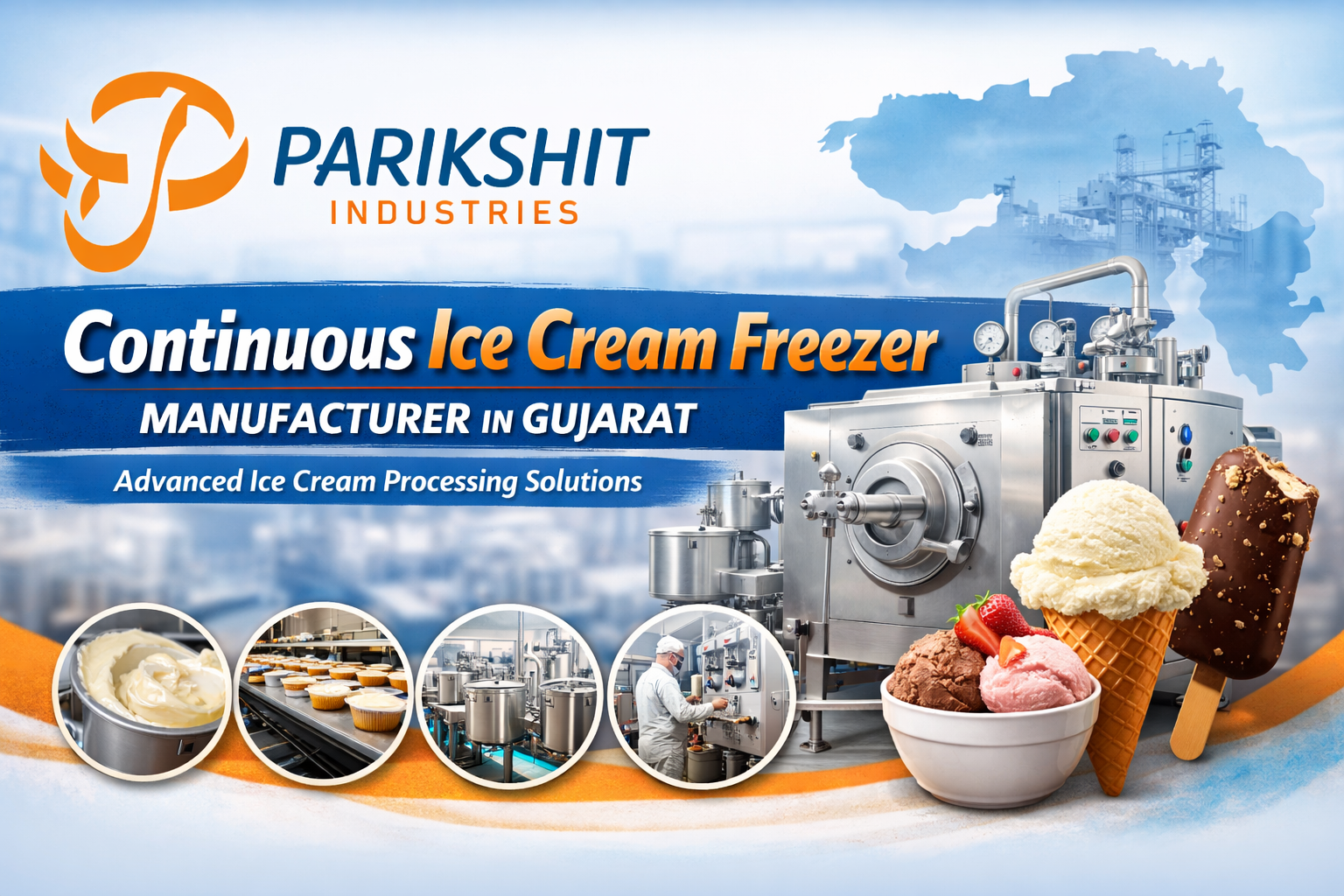
Continuous Ice Cream Freezer Manufacturer in Gujarat
Advanced Ice Cream Processing Solutions by Parikshit Industries, Ahmedabad
India's Ice Cream Industry and Continuous Freezing Technology
India's ice cream industry has seen rapid advancement over the past decade, driven by evolving consumer preferences, rising quality expectations, and the expansion of organized dairy and frozen dessert brands. At the core of modern ice cream manufacturing is one essential machine: the continuous ice cream freezer. For large-scale producers, this equipment directly influences product texture, overrun consistency, hygiene control, and overall production efficiency. In Gujarat, a state with a strong dairy foundation and developed industrial infrastructure, the demand for dependable continuous ice cream freezer solutions continues to grow steadily.
Parikshit Industries, based in Ahmedabad, Gujarat, operates within this ecosystem as a specialized manufacturer of ice cream plants and processing machinery. With a focused emphasis on engineering-driven solutions, the company supports ice cream manufacturers with equipment designed to meet modern food processing standards while ensuring stable and reliable operation.
Understanding Continuous Ice Cream Freezing Technology
A continuous ice cream freezer is engineered to produce ice cream through an uninterrupted production cycle, unlike batch freezers that operate in limited volumes. This technology allows manufacturers to achieve uniform texture, controlled air incorporation, and consistent product quality across extended production runs. Continuous freezers are especially suitable for medium to high-capacity plants where throughput stability and process control are essential.
The freezer performs three functions simultaneously. It freezes the ice cream mix under controlled temperature conditions, incorporates air to achieve the required overrun, and delivers a smooth, homogeneous product ready for downstream processes such as filling, molding, or extrusion. The accuracy of this process directly impacts mouthfeel, melting behavior, and overall sensory quality.
Role of Continuous Ice Cream Freezers in Modern Production Lines
Within an integrated ice cream plant, the continuous freezer functions as a central processing unit linking upstream and downstream systems. Milk storage tanks, pasteurizers, homogenizers, and ageing tanks condition the mix before freezing. After processing in the freezer, the product flows to cup filling lines, cone machines, stick ice cream systems, or hardening tunnels depending on the final format.
Continuous freezing supports uninterrupted production, which minimizes handling risks and improves hygiene control. Automated operation also enables better monitoring of process parameters, helping manufacturers maintain consistent output during long operating shifts. For producers in Gujarat supplying regional or national markets, this operational reliability is critical for maintaining supply continuity.
Key Engineering Considerations in Continuous Ice Cream Freezers
Engineering quality plays a decisive role in the long-term performance of a continuous ice cream freezer. Machines must be constructed using food-grade materials capable of withstanding thermal stress, pressure variations, and frequent cleaning cycles. Precision machining of internal components such as freezing cylinders, dashers, and air control systems is essential to ensure stable and repeatable results.
Accurate temperature control is another critical factor. Even small deviations can influence ice crystal formation, leading to grainy textures or inconsistent product density. Modern continuous freezers are designed to maintain precise temperature profiles while accommodating different mix formulations and varying fat content levels.
From an operational standpoint, ease of cleaning and maintenance significantly affects plant efficiency. Well-engineered freezers provide quick access to critical components, reducing downtime during sanitation and routine servicing. This is particularly important for manufacturers operating under strict food safety and hygiene requirements.
Applications Across Ice Cream Product Categories
Continuous ice cream freezers are used across a wide range of ice cream and frozen dessert applications. Their adaptability allows manufacturers to process multiple formulations without compromising product quality. Common applications include:
- Standard dairy ice cream production
- Premium and high-fat ice cream variants
- Frozen desserts and compound-based products
- Soft serve base preparation for further processing
- Novelty ice cream products requiring uniform texture
This versatility makes continuous freezers a practical choice for manufacturers aiming to expand product portfolios while maintaining production efficiency.
Why Gujarat Is a Strategic Location for Ice Cream Equipment Manufacturing
Gujarat occupies a strategic position in India's dairy and food processing sector. A strong cooperative dairy network, skilled engineering talent, and well-developed industrial infrastructure make the state an ideal base for manufacturing food processing machinery. Ahmedabad, in particular, has emerged as a hub for specialized equipment manufacturers serving both domestic and export markets.
Ice cream producers in Gujarat benefit from proximity to raw material sources, technical service providers, and logistics networks. Equipment manufacturers operating in this region are well-positioned to understand local production challenges while aligning with national and international compliance standards. This regional advantage supports efficient customization, responsive technical support, and streamlined project execution.
Parikshit Industries' Approach to Continuous Ice Cream Freezer Solutions
Parikshit Industries designs and manufactures continuous ice cream freezers as part of its complete ice cream plant solutions. The company's approach focuses on engineering reliability, functional performance, and seamless integration with full production lines. Each freezer is developed to work in coordination with associated machinery such as pasteurizers, homogenizers, ageing tanks, and filling systems.
Customization is central to addressing varied manufacturing requirements. Production capacities, product formats, and plant layouts differ across facilities. By aligning equipment design with specific operational needs, Parikshit Industries supports consistent production performance and long-term equipment reliability.
Quality Assurance and Manufacturing Standards
Quality assurance is fundamental in industrial food machinery manufacturing. Continuous ice cream freezers are subjected to thorough testing to verify mechanical stability, temperature control accuracy, and hygienic design compliance. The use of high-grade materials and controlled fabrication processes ensures durability under demanding operating conditions.
Comprehensive inspection and performance validation help reduce operational risks once the equipment is commissioned. For manufacturers focused on maintaining uniform product quality, this emphasis on testing and verification plays an important role in equipment selection.
Integration With End-to-End Ice Cream Plant Solutions
A continuous ice cream freezer is rarely used as a standalone machine. Its effectiveness depends on upstream process consistency and downstream handling efficiency. Integrated plant design ensures that mix preparation, freezing, filling, and hardening stages function in coordination.
End-to-end solutions typically include:
- Project consultation and capacity planning
- Plant layout and technical design
- Manufacturing and supply of machinery
- Installation and commissioning
- Operator training and technical guidance
This integrated approach shortens commissioning timelines, reduces operational risks, and supports a smooth transition into full-scale production. Manufacturers benefit from having a single point of technical accountability throughout the project lifecycle.
Operational Efficiency and Long-Term Performance
Beyond installation, long-term operational performance determines the actual value of a continuous ice cream freezer. Stable operation, predictable output, and manageable maintenance requirements contribute to overall plant efficiency. Machines designed with intuitive controls and accessible components allow operators to manage production with greater consistency.
Energy efficiency is also an important consideration, particularly in large-scale plants. Optimized refrigeration systems and efficient heat transfer design help reduce energy consumption while maintaining required freezing performance.
How Manufacturers Can Evaluate the Right Continuous Ice Cream Freezer
Choosing the right continuous ice cream freezer requires structured evaluation rather than focusing solely on capacity. Manufacturers should assess production objectives, product range, hygiene standards, and long-term scalability.
Key evaluation factors include:
- Compatibility with existing processing equipment
- Consistency of overrun and texture control
- Ease of cleaning and maintenance
- Availability of technical support and spare parts
- Compliance with food safety standards
A carefully selected freezer supports current production requirements while allowing flexibility for future expansion and product diversification.
Conclusion
The continuous ice cream freezer is a core component of modern ice cream manufacturing, directly influencing product consistency, production efficiency, and operational stability. For manufacturers in Gujarat, access to specialized engineering expertise and dependable equipment solutions is essential in a competitive and expanding market. By emphasizing functional design, quality assurance, and integrated plant solutions, manufacturers can build production systems that support consistent output and long-term operational performance.
Frequently Asked Questions
Get in Touch
Our Blogs
- Vertical Batch Freezer Uses in Dairy Processing
- Gelato Production Machine
- Homogenizer Exporter
- Pasteuriser Uses in Milk Processing
- Pasteuriser Uses in Milk Processing
- Ageing Vat Uses in Dairy Processing
- Pasto Matic Exporter
- Candy Plant Uses in Ice Candy Production
- Fruit Feeder Uses in Ice Cream Production
- Hardening Tunnel Uses in Ice Cream Production
- Hardening Tunnel Uses in Ice Cream Production
- How Fruit Feeder Works
- Ice Cream Machine Manufacturer in Ahmedabad
- Candy Plant Exporter
- Ageing Vat Exporter
- How Cup and Cone Filling Machine Works
- Benefits of Batch Freezer in Ice Cream Making
- Batch Freezer Supplier
- Automatic Cup and Cone Filling Machine Uses
- How Ageing Vat Works
- Ageing Vat Supplier
- Turnkey Ice Cream Plant Manufacturer
- Ice Cream Making Plant Supplier in India
- Ice Cream Machinery Manufacturer in India
- Ice Cream Machinery Manufacturer in Ahmedabad
- Ice Cream Manufacturing Plant Supplier
- Commercial Ice Cream Plant Manufacturer
- Commercial Ice Cream Plant Manufacturer
- Ice Cream Production Plant Manufacturer in Ahmedabad
- Ice Cream Production Plant Manufacturer in Ahmedabad
- Ice Cream Processing Plant Manufacturer in India
- Ice Cream Processing Plant Manufacturer in India
- Industrial Ice Cream Plant Manufacturer
- Ice Cream Machinery Manufacturer in Gujarat
- Ice Cream Factory Equipment Supplier in Gujarat
- Complete Ice Cream Plant Setup in India
- Automatic Cup and Cone Filling Machine for Ice Cream Industry
- Pasteuriser for Dairy Industry
- Ice Cream Processing Plant Manufacture
- Candy Plant Supplier
- Ice Cream Plant Supplier in Gujarat
- Ice Cream Plant Manufacturer in Ahmedabad
- Ice Cream Plant
- Automatic Cup and Cone Filling Machine Exporter
- Candy Plant Manufacturer
- Batch Freezer Manufacturer
- Automatic Cup and Cone Filling Machine Supplier
- Ageing Vat for Ice Cream Industry
- Benefits of Automatic Cup and Cone Filling Machine
- Automatic Cup and Cone Filling Machine
- Ageing Vat Manufacturer
- Ice Cream Plant
- Ice Cream Processing Equipment Manufacturing in India
- Ice Cream Homogenizer Supplier in Gujarat
- Ice Cream Homogenizer Machine Manufacturer in Ahmedabad
- Ice Cream Freezer Machine Near Me
- Ice Cream Freezing System Manufacturing in India
- Ice Cream Freezing Equipment Supplier in Gujarat
- Ice Cream Batch Freezer Manufacturer in Ahmedabad
- Ice Cream Mixer Machine Near Me
- Ice Cream Mixing System Manufacturing in India
- Ice Cream Blending Machine Supplier in Gujarat
- Ice Cream Mixing Machine Manufacturer in Ahmedabad
- Ice Cream Filling Equipment Near Me
- Ice Cream Filling System Manufacturing in India
- Ice Cream Filling Machine Manufacturer in Ahmedabad
- Ice Cream Production Unit Near Me
- Ice Cream Processing Plant Manufacturing in India
- Ice Cream Factory Equipment Supplier in Gujarat
- Ice Cream Production Plant Manufacturer in Ahmedabad
- Ice Cream Equipment Near Me
- Ice Cream Packaging Machine Supplier in India
- Ice Cream Packaging Machine Supplier in Gujarat
- Ice Cream Unit Manufacturing in India
- Ice Cream Production Plant Manufacturer in Ahmedabad
- Ice Cream Plant Manufacturers in India
- Ice Cream Making Machine Manufacturer in Ahmedabad
- Ice Cream Making Plant Supplier in India
- Candy Plant Machine Manufacturing in Gujarat
- Candy Plant Machine Supplier in Ahmedabad
- Candy Plant Manufacturer in India
- Ice Cream Cone Filling Machine Supplier in Gujarat
- Ice Cream Machine Supplier in India
- Continuous Ice Cream Freezer Manufacturing in Ahmedabad
- Candy Plant Machine Supplier in Ahmedabad
- Continuous Ice Cream Freezer Supplier in Ahmedabad
- Ice Cream Plant Manufacturers in Gujarat
- Ice Cream Plant Manufacturing in Gujarat
- Cup Cone Filling Machine Manufacturer in Ahmedabad
- Ice Cream Plant Manufacturer in India
- Ice Cream Plant Manufacturer in India
- Continuous Ice Cream Freezer Manufacturer in India
- Continuous Ice Cream Freezer in Gujarat
- Cup Cone Filling Machine Manufacturer in Ahmedabad
- Ice Cream Machine Manufacturer in Gujarat
- Ice Cream Plant in Ahmedabad, Gujarat
- Ice Cream Plant Supplier in Ahmedabad
- Ice Cream Machine Manufacturer Supplier in Ahmedabad
- Continuous Ice Cream Freezer Manufacturer in Gujarat
- Continuous Ice Cream Freezer in Ahmedabad
- Continuous Ice Cream Freezer in India
- Ice Cream Machinery Manufacturers in India
- Ice Cream Plant Manufacturer Gujarat
- Ice Cream Machine Manufacturer Ahmedabad
- Ice Cream Machine Manufacturers in India
- Ice Cream Machinery Manufacturers in Gujarat
- Ice Cream Machine Manufacturers in Ahmedabad
- Ice Cream Machine Manufacturers in Gujarat
- Ice Cream Machine Manufacturers