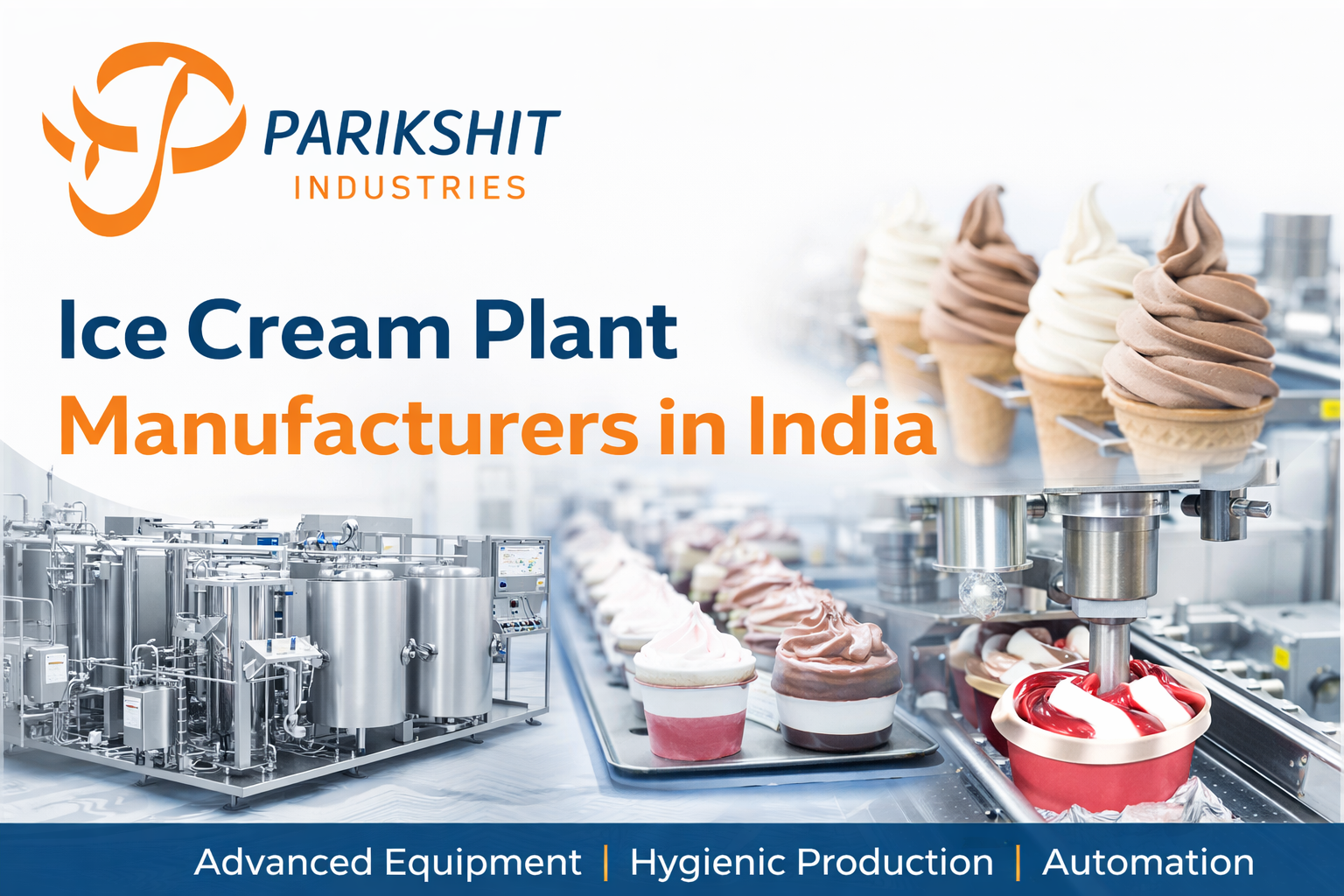
Ice Cream Plant Manufacturers in India | Parikshit Industries
Parikshit Industries · Ahmedabad, India
Ice Cream Plant Manufacturers in India
India's food processing industry has experienced significant growth, particularly in the dairy and frozen dessert segment. Ice cream plant manufacturers in India play an important role in supporting this expansion by providing advanced, reliable, and hygienic production systems.
Ice Cream Plant Manufacturers in India
These manufacturers design and supply fully integrated plants that enable businesses to produce ice cream efficiently while maintaining consistent quality and food safety standards. With rising demand for packaged and premium ice cream products across both urban and rural markets, the need for automated and scalable production systems has become increasingly important. Indian manufacturers are focusing on innovation, energy efficiency, and compliance with food safety regulations to meet the evolving needs of the industry.
Ice cream plant manufacturers in India specialize in developing complete production solutions that integrate multiple processes into a seamless workflow. These systems are engineered using food-grade materials and modern technologies to ensure durability, hygiene, and operational efficiency.
The manufacturing process includes designing equipment such as mix preparation tanks, pasteurizers, homogenizers, aging tanks, continuous freezers, and packaging units. Each component is precisely engineered to perform its function while remaining fully compatible with the overall system. Manufacturers also emphasize customization, allowing businesses to choose plant capacity, automation level, and product types based on their specific production goals. This flexibility enables small, medium, and large-scale producers to adopt industrial ice cream production systems more effectively.
Core Components of an Ice Cream Plant
An industrial ice cream plant consists of multiple interconnected units that work together to complete the production cycle. These components are designed to handle high volumes while maintaining consistency and hygiene.
Mix preparation and blending systems
Pasteurization units for microbial safety
Homogenizers for smooth texture
Aging tanks for improved consistency
Continuous freezers for controlled freezing
Flavor dosing and inclusion systems
Automatic filling and packaging machines
Hardening tunnels for final solidification
Each of these components is manufactured with precision to ensure smooth operation, consistent output, and minimal downtime.
Production Process in Industrial Ice Cream Plants
The production process in an ice cream plant follows a structured sequence to achieve the desired taste, texture, and stability. Manufacturers design equipment that supports each stage with accuracy and efficiency.
The process begins with mixing raw ingredients such as milk, cream, sugar, and stabilizers. The mixture is then pasteurized to eliminate harmful microorganisms and homogenized to create a uniform structure. After this, the mix is cooled and stored in aging tanks, where it develops improved consistency and stability. During the freezing stage, partial solidification takes place along with controlled air incorporation, giving ice cream its light and creamy texture. Flavoring ingredients are added at this stage. Finally, the product is packaged and transferred to hardening tunnels, where it is exposed to low temperatures for complete solidification.
Key Features Offered by Ice Cream Plant Manufacturers
Manufacturers in India focus on delivering plants that are efficient, reliable, and aligned with industry standards. Modern ice cream plants include several advanced features that enhance productivity and ensure consistent product quality.
Fully automated operation to reduce manual handling
Hygienic construction using stainless steel
Energy-efficient refrigeration systems
Precise temperature and process control
Modular design for easy expansion
Low maintenance with high durability
These features make industrial ice cream plants suitable for continuous production in demanding operational environments.
Applications of Ice Cream Plants in India
Ice cream plants are widely used across different segments of the food industry. Their versatility allows manufacturers to produce a variety of frozen desserts and dairy-based products.
Dairy processing units
Ice cream manufacturing companies
Frozen dessert brands
Food processing industries
Catering and large-scale food service providers
The ability to manage multiple product variations makes these plants a practical investment for businesses aiming to expand their offerings.
Factors to Consider When Choosing Ice Cream Plant Manufacturers in India
Selecting the right manufacturer is a critical decision that directly impacts production efficiency and long-term performance. Businesses should carefully evaluate several factors before finalizing a supplier.
Manufacturing experience and technical expertise
Compliance with food safety and quality standards
Customization options for plant capacity and design
After-sales support and service availability
Energy efficiency and operational cost considerations
A well-designed plant not only enhances production efficiency but also ensures consistent product quality and regulatory compliance.
Importance of Hygiene and Food Safety Standards
Hygiene is a crucial aspect of ice cream production. Manufacturers in India follow strict guidelines to ensure that all equipment meets food-grade standards. The use of stainless steel, clean-in-place systems, and temperature-controlled environments helps maintain product safety.
Regular monitoring, microbial testing, and proper documentation are essential for maintaining compliance with food safety regulations. A hygienic production environment not only protects consumers but also strengthens brand credibility and trust.
Role of Automation in Modern Ice Cream Plants
Automation plays a key role in improving efficiency and consistency in ice cream production. Modern plants are equipped with advanced control systems that allow operators to monitor and adjust parameters in real time.
Automated systems help reduce human error, improve production speed, and maintain uniform quality across batches. They also contribute to optimized energy usage and reduced operational costs, making them highly valuable for industrial applications.
Why India is a Growing Hub for Ice Cream Plant Manufacturing
India has emerged as a strong manufacturing hub for food processing equipment, including ice cream plants. The availability of skilled engineers, cost-effective production capabilities, and increasing demand for processed food products have supported this growth. Manufacturers in India are continuously investing in innovation and advanced technologies to meet global standards. This enables them to serve both domestic and international markets with reliable and efficient production solutions.
Future Trends in Ice Cream Plant Manufacturing
The future of ice cream plant manufacturing is driven by technological advancements and evolving consumer preferences. Manufacturers are focusing on improving energy efficiency, automation, and sustainability.
Innovations such as smart monitoring systems, eco-friendly refrigeration technologies, and modular plant designs are expected to shape the industry. These developments will help businesses enhance efficiency while reducing their environmental impact.
Frequently Asked Questions
An industrial ice cream plant is a fully integrated system used for large-scale ice cream production. It combines processes such as mixing, pasteurization, freezing, and packaging into a single streamlined setup.
Manufacturers design equipment with precise control systems that regulate temperature, pressure, and processing conditions. This ensures consistent texture, flavor, and safety across all batches.
Ice cream plants are available in various capacities based on production requirements. Manufacturers provide customized solutions suitable for small, medium, and large-scale operations.
Automation improves efficiency by minimizing manual intervention, ensuring consistent quality, and optimizing production speed. It also supports better hygiene and reduces the risk of operational errors.
Most equipment is manufactured using food-grade stainless steel to ensure durability, corrosion resistance, and compliance with hygiene standards.
Yes, manufacturers offer customization options that allow businesses to produce a wide range of products, including gelato, soft serve, and other frozen desserts.